Whole forests along the American coast are dying on their feet, turned to fields of bleached dead trees by salt water creeping inland
Drive the back roads of the low Atlantic coast and you will start to see them: stands of pale, leafless trees, bone-white and lifeless, standing in water where a green wood used to be. They are called ghost forests, and they are the sea writing its arrival on the land.
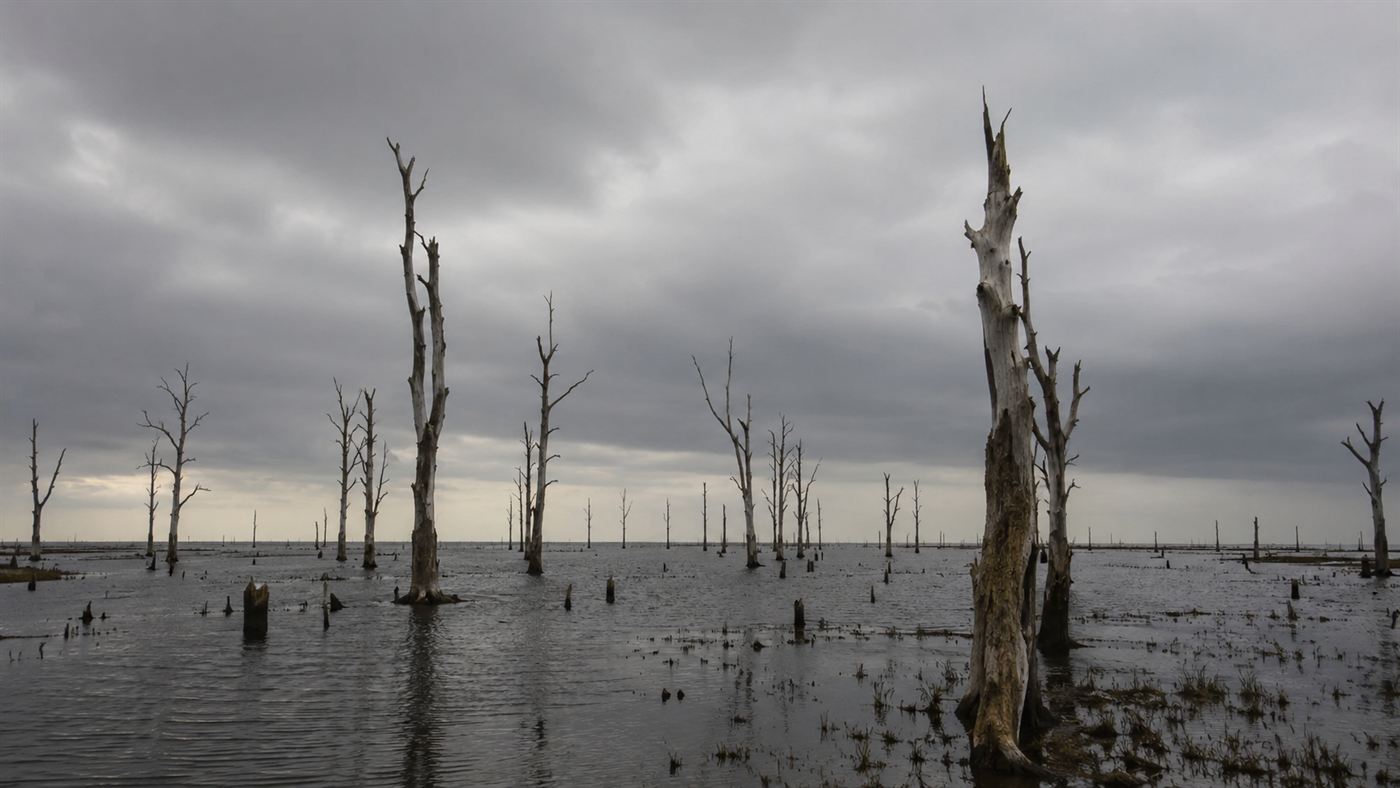
A ghost forest of dead trunks stands where a living coastal wood once grew. Illustration: Watts & Wild.
Along stretches of the American coast, from the Chesapeake Bay down through the Carolinas and up into New Jersey, there are woods where nothing green remains. The trees still stand, tall and grey, but they are dead, their bark peeling, their branches bare, rising out of marsh grass or open water like the masts of drowned ships.
These are ghost forests, and they are not the work of fire or disease. They are the slow, visible footprint of a rising sea, killing the coast one tree at a time, and they are appearing faster and over more of the shoreline than they used to.
The short version is that the ocean is moving inland, that it is poisoning the forests it reaches before it ever drowns them, and that the pale dead trees are the clearest sign on land of a change most of us only read about.
How salt water kills a forest
Trees like the Atlantic white cedar and the loblolly pine that grow near the coast can live with fresh water, but not with salt. As the sea rises and the land slowly sinks, that salt water pushes further inland through the soil and up the creeks, a process called saltwater intrusion, until it reaches roots that were never meant to drink it.
The salt does not have to flood the trees to kill them. It only has to seep into the ground they stand in, drawing water out of their roots and poisoning them from below. Over a few seasons the leaves thin, the crowns die back, and the wood is left standing dead, too stiff and slow to move out of the water's way.
The edge of a rising sea
What makes ghost forests so striking is that they mark a boundary you can actually stand at and see moving. On one side is living forest, on the other bare grey trunks and then marsh, and that line is creeping steadily inland as sea level rise pushes the salt a little further every year.
Storms speed the saltwater intrusion up. A single big surge can shove salt water deep into a coastal wood in a day, and a drought that lowers the freshwater flowing seaward lets the salt reach even further. Each such event can kill a new band of trees at once, leaving another ghost forest to bleach in the sun where a green one stood the year before.
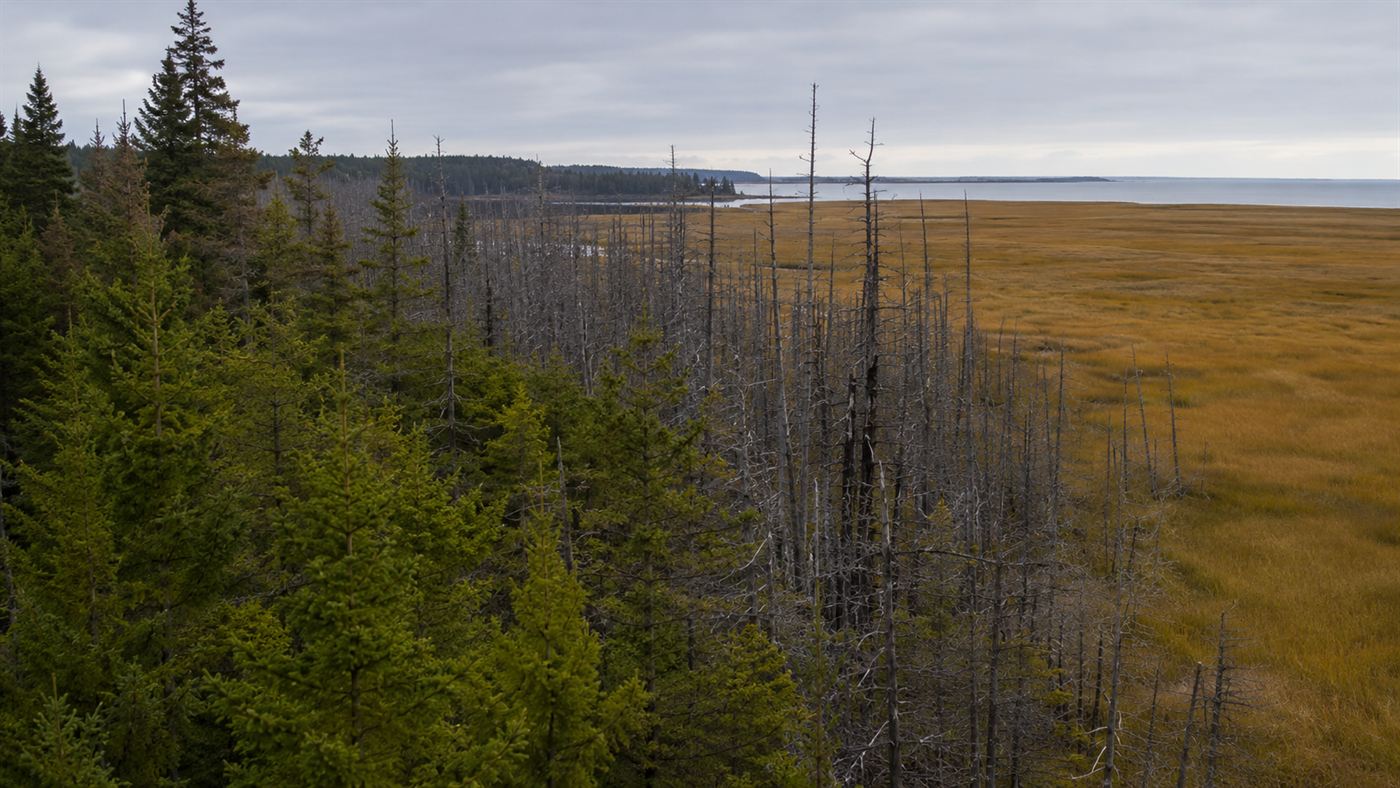
Why ghost forests are spreading so fast
Coasts have always shifted, and forests have turned to marsh before over long ages. What is different now is the speed. Sea level rise along much of the US East Coast is running faster than the global average, partly because the land there is also sinking, and that combination is pushing the salt inland at a pace forests cannot outrun.
Studies tracking the shoreline have found ghost forests expanding rapidly in recent decades, swallowing thousands of acres of woodland and turning them to open marsh. Scientists sometimes call these dying stands the leading edge of climate change, because here the abstract idea of a rising sea has a very concrete, very visible face.
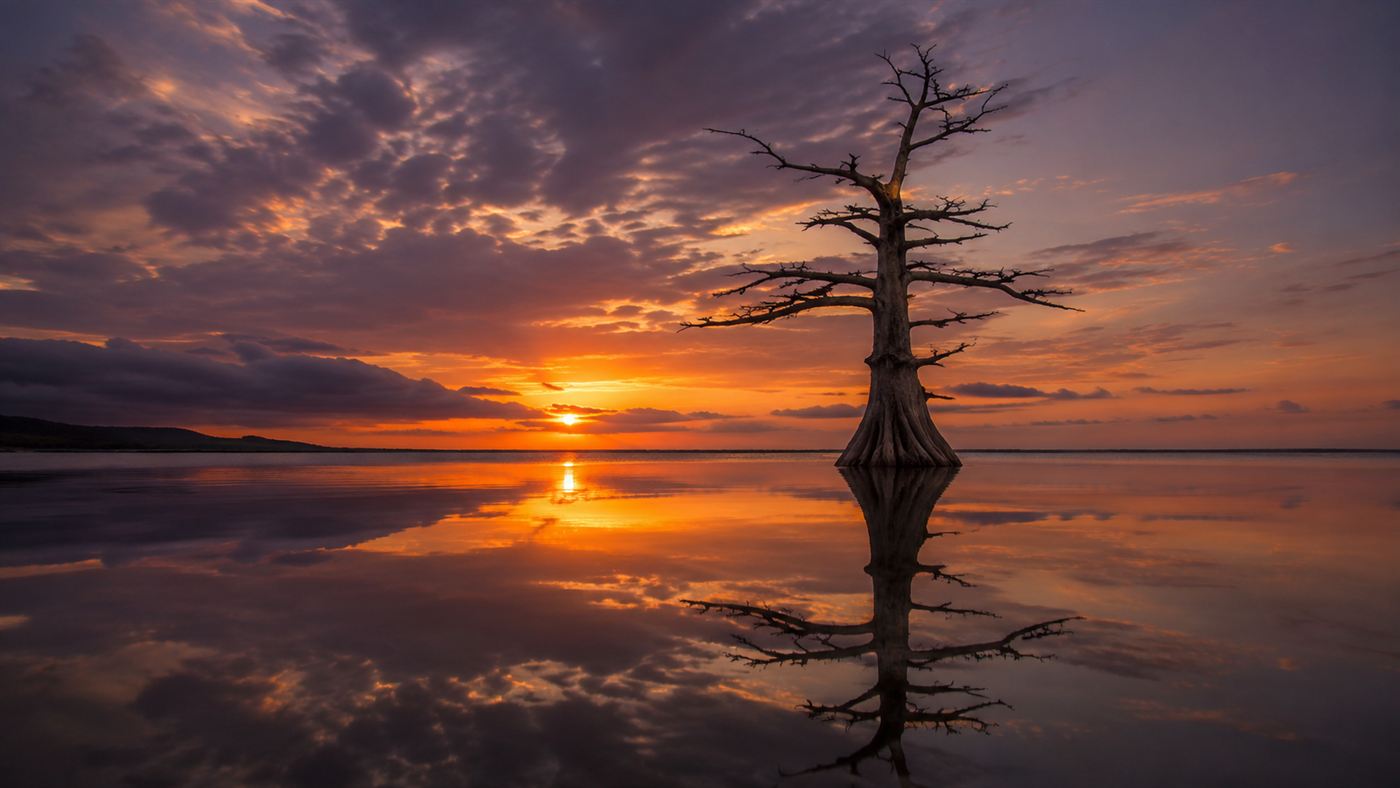
Is a ghost forest all bad news?
Here the picture gets more complicated than pure loss. When a coastal forest dies and becomes salt marsh, something is destroyed, but something is also born, because marshes are among the most valuable habitats on Earth. They shelter fish and birds, they soak up carbon, and they blunt the storms that batter the coast behind them.
So the same event can be read two ways at once, as a forest lost and a marsh gained, and in the short run that migration of habitat can even be healthy. The catch is that it only works if the marsh has somewhere to move into, and if the sea does not keep rising so fast that it eventually drowns the marsh as well.
The honest catch
It is tempting to make ghost forests a simple parable of doom, and just as tempting to wave them away as nature doing what it always does, and both are too easy. The dying is real and largely driven by warming that we have caused, so calling it natural is a dodge. But the coast is also genuinely transforming, not just ending, and the incoming marsh has real value of its own.
The honest catch is that this is a change we can no longer fully stop, only shape. You cannot hold the sea back from a whole shoreline, and the ghost forests are a quiet warning that some of the future is already decided. The most useful response is not only to mourn the pale dead trees but to give the marshes room to move inland behind them, and to remember, every time we pass a ghost forest, that the sea is not coming one day. It is already here.
The pale dead trees on the coast are the sea's arrival made visible, years before the water ever reaches the towns behind them. Should we mourn a ghost forest, or make room for the marsh that comes next? Tell us what you think in the comments.
Related reading: the Great Salt Lake, a different water crisis unfolding in slow motion. See also the Ogallala Aquifer we are draining faster than the rain can refill it, and the Elwha, where a river was set free by tearing down a dam.