Long before anyone had heard of Tesla, Britain quietly ran the biggest fleet of electric vehicles on Earth, and almost every one of them was a milkman's float humming down the street at dawn
We talk about electric vehicles as if they were invented in the last decade or two. One country had tens of thousands of them whirring around its streets in the 1960s, so ordinary that nobody thought of them as the future at all. They were just how the milk arrived.
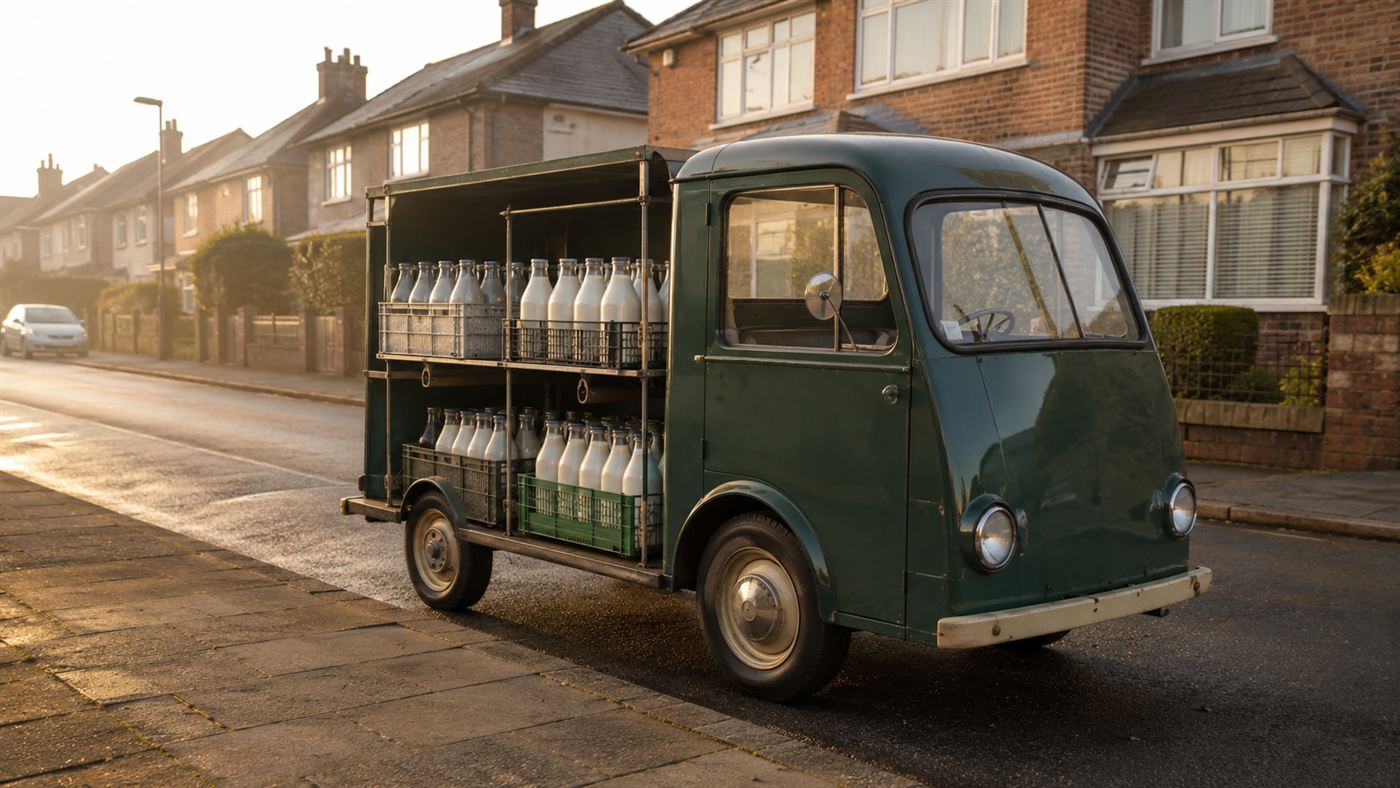
A British electric milk float, once the most common electric vehicle on Earth. Illustration: Watts & Wild.
In August 1967, the body that represented Britain's electric vehicle makers put out a quietly astonishing claim. As the record of the milk float notes, the UK Electric Vehicle Association announced that Britain had more battery electric vehicles on its roads than the rest of the world combined, and that almost all of them were milk floats. While the rest of the planet ran on petrol and diesel, one country was already the undisputed electric vehicle capital of the world, and British electric milk floats had got it there by accident, one pint of milk at a time.
The strangest part is that nobody at the time thought of it as visionary. It was simply the obvious, cheap, sensible way to deliver milk.
The job that was perfect for a battery
To see why, picture the round.
A milk float spends its morning crawling along residential streets, stopping every few houses, idling while the milkman carries bottles to doorsteps, then creeping forward again.
It covers a short, fixed route, never goes fast, and comes home to the same depot every day.
For that exact pattern of work, a petrol engine is almost the worst possible choice, forever stopping and restarting, while an electric motor is close to ideal.
So the dairies went electric without any grand mission.
The floats ran on heavy lead acid batteries, the same basic chemistry as a car's starter battery, and crawled along at a gentle pace that suited a street full of pedestrians and parked cars.
Every night they plugged in at the depot and recharged on cheap off peak power, ready for the next dawn.
And crucially, they were almost silent, which mattered enormously when your vehicle is trundling past bedroom windows at four in the morning.
A roaring diesel would have woken the whole street.
How British electric milk floats made an electric nation
Multiply that logic across thousands of dairies and you get a genuinely remarkable picture.
As a history of Britain's electric commercial vehicles records, the 1950s and 1960s were the golden age of the milk float, with the dairies needing a vehicle quiet enough for early rounds and finding that electricity answered perfectly.
The result was a fleet of electric vehicles so large that it dwarfed every other country's, decades before the word Tesla meant anything but a dead physicist.
And it was woven into daily life.
The electric float, the chink of glass bottles in their crates, the milkman gliding silently from house to house in the half light, were a fixed part of the British morning, an everyday piece of infrastructure that just happened to be the most advanced electric road transport on the planet.
The future had arrived, and it was wearing a flat cap and carrying a bottle of gold top.

Why the electric capital faded
If electric vehicles were so dominant here, what happened?
The answer is not that the technology failed.
It is that the job disappeared.
From the 1970s onwards, supermarkets began selling cheap milk in cartons and plastic bottles, fridges meant families could buy a week's worth at once, and the daily doorstep delivery that the whole electric fleet existed to serve went into a long decline.
As the rounds shrank, so did the floats, and the country that had quietly led the world in electric vehicles let that lead melt away with the milkman.
There is a small, fitting coda.
As the doorstep delivery company Milk & More describes, it has in recent years gone back to its electric roots, running a modern fleet of electric floats again to bring milk in glass bottles to the door, the old idea rediscovered just as the rest of the world finally catches up to electric delivery.
The honest catch
It is tempting to wave the milk float around as proof that Britain was decades ahead on clean transport, and that is where a little honesty is needed.
The dairies did not go electric to save the planet, they went electric because it was cheaper and quieter for one very particular task, and the floats only worked so well because they were slow, short range and never had to do anything demanding.
The same lead acid batteries that suited a gentle milk round would have been useless for a fast, long distance car, which is exactly why electric vehicles stayed stuck in the slow lane of delivery work for so long and did not take over the roads.
So the milk float is not really a story about Britain being ahead of its time.
It is a sharper and more useful lesson than that.
A technology does not win because it is clever or clean in the abstract, it wins where it genuinely fits the job, and the electric float fit the milk round perfectly while fitting almost nothing else.
The reason electric vehicles are spreading everywhere now is not that someone finally invented them.
It is that the batteries finally got good enough to do all the other jobs the milkman never asked of them.
Britain was the electric vehicle capital of the world in the 1960s and barely noticed, because its huge electric fleet was just the floats that brought the milk.
What everyday technology around you right now might turn out, decades from now, to have been ahead of its time? Tell us what you think in the comments.
Related reading: An EV battery loses only 2.3 percent of capacity a year across 22,700 real cars, so it still holds more than 80 percent after eight years on the road.