There is a lake of tar in Trinidad that you can walk across, and it never runs out
On the southwest coast of Trinidad sits a lake unlike any other on Earth. It holds no water. Instead it is filled with millions of tonnes of black, gleaming tar, firm enough in places to walk on, soft enough in others to swallow a careless boot. Pitch Lake is the largest natural deposit of asphalt in the world, and it has been quietly refilling itself for longer than anyone can measure.
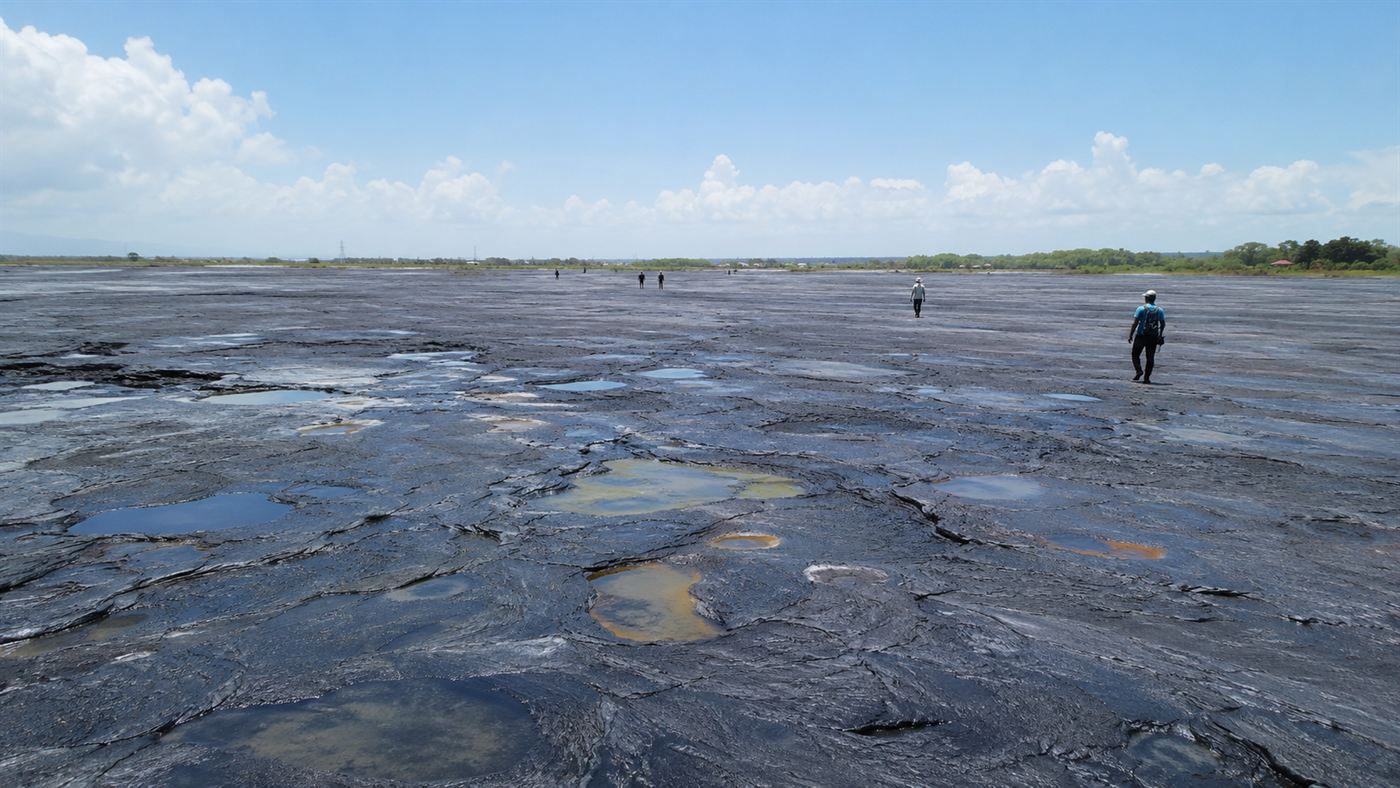
From a distance it looks like a car park; up close it is a living, breathing lake of tar. Illustration: Watts & Wild.
Most of the world's oil hides deep underground, reached only by drills and pumps. In one corner of the Caribbean, the planet skips all of that and simply pushes its petroleum up to the surface, where it pools in the open air. The result, known as the Pitch Lake, is one of the strangest energy landscapes on Earth, a place where you can stand directly on top of a fossil-fuel deposit.
It is part natural wonder, part industrial mine, and part graveyard of the Ice Age, all rolled into roughly forty hectares of glistening black.
A lake that is not made of water
At first glance the Pitch Lake can look almost disappointing, a wide, dark, slightly wrinkled plain that could be mistaken for a vast tarmac yard. The wonder is in what it actually is. Beneath that crust lies an estimated ten million tonnes of bitumen, the same thick, sticky substance used to surface roads, plunging to around seventy-five metres deep at the centre.
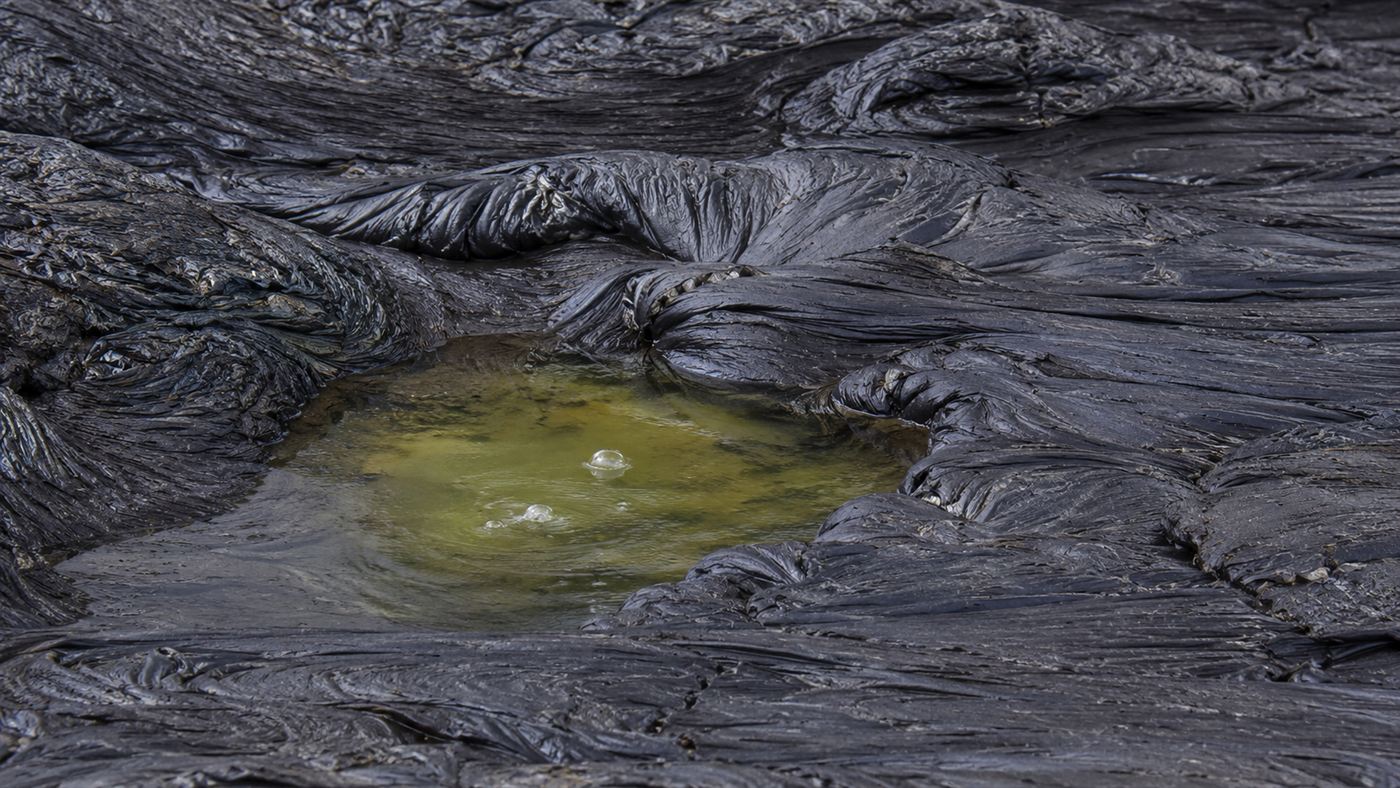
Scattered across the surface are pools of rainwater stained odd colours, gentle bubbles of escaping gas, and a faint smell of sulphur. The whole thing moves with agonising slowness, folding and recycling itself over years, so that the lake you see today is not quite the lake that was there a generation ago.
How the Pitch Lake keeps refilling itself
The reason the lake exists at all is a quirk of geology. Trinidad sits where great slabs of the Earth's crust grind against one another, and a deep fault acts like a straw, drawing oil-rich material up from far below. As that material reaches the surface, its lighter, more liquid parts evaporate away, leaving the heavy black bitumen behind, and fresh supplies keep welling up from beneath to take their place.
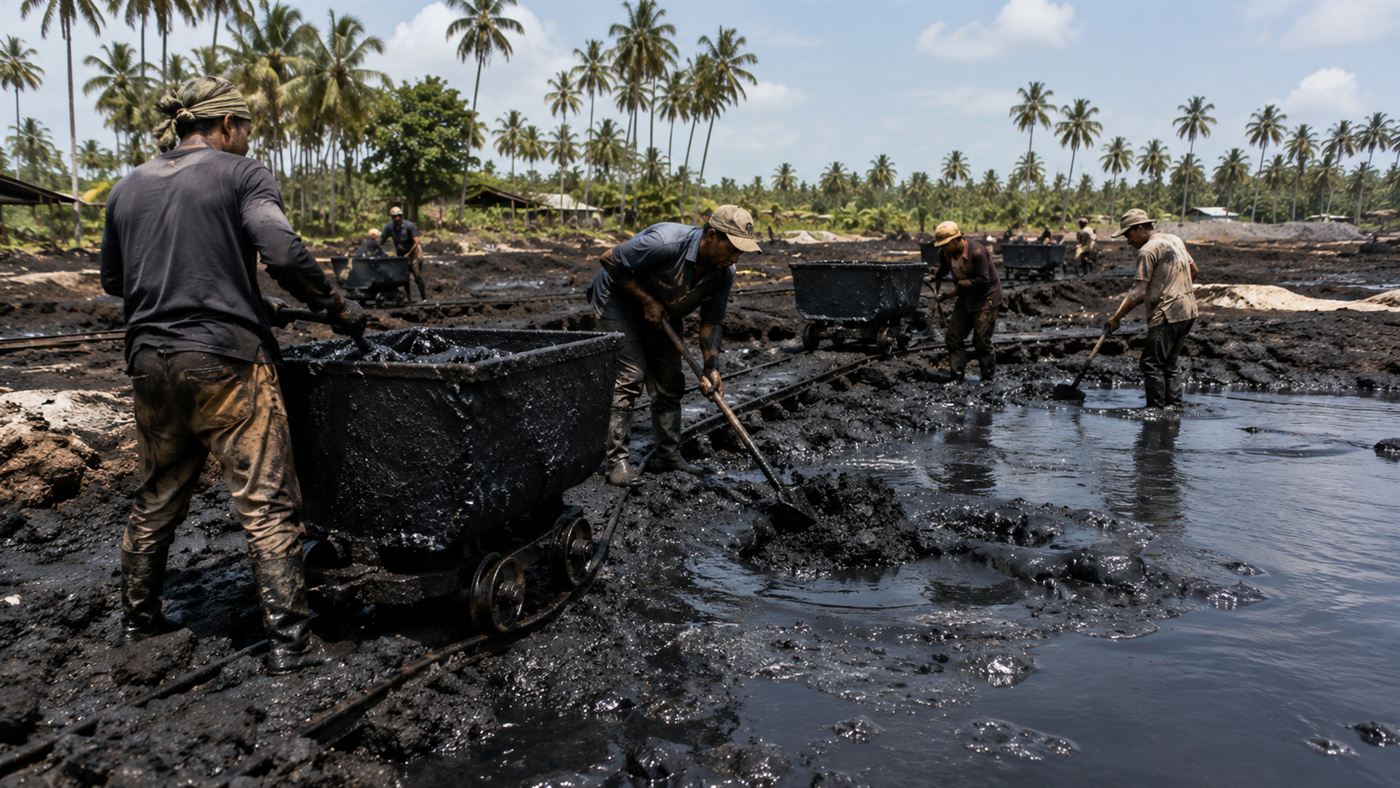
That is why the lake is, in effect, bottomless in a practical sense. People have been digging asphalt out of it on an industrial scale for well over a century, hauling away shipload after shipload, and yet the level barely changes. The Earth simply refills the bowl as fast as we empty it, a slow, steady fountain of tar.
Walking on a lake of tar
Visitors really can stroll out across much of the lake, usually with a guide who knows which patches are safe. The firmer crust holds a person's weight comfortably, with a slight springiness underfoot, as if walking on cooling toffee. Stand still too long in the wrong spot, though, and you will feel the tar begin to grip your shoes and pull, a gentle but unmistakable reminder that this is not solid ground.
That softness is exactly what makes the lake so dangerous to anything that cannot read the warning signs. Over thousands of years, animals that wandered onto it became stuck, sank, and were swallowed whole. The pitch is an almost perfect preservative, sealing whatever it takes from air and decay.
A tar pit full of monsters
Because of that, the Pitch Lake has acted as a natural time capsule, and digging into it has turned up astonishing things. The bones of Ice Age giants, including mastodons and enormous ground sloths, have emerged from the tar, alongside ancient crocodilians and the tools and pottery of people who lived there long ago. Each one was pulled down, held, and preserved for the future.
The lake's fame stretches back centuries. The English adventurer Sir Walter Raleigh visited in 1595 and used its pitch to caulk and repair his ships, delighted to find an endless supply of tar in the middle of nowhere. Today scientists are interested in something smaller still: the hardy microbes that live in its oily pools, which may hint at how life could survive in the tar lakes thought to exist on other worlds.
Can you really walk on Pitch Lake?
Yes, carefully, and that is half the appeal. On the firm areas the surface is a stable, semisolid crust, and guided visitors walk out onto it every day to see the bubbling pools and watch fresh pitch ooze up. The danger lies only in the soft pockets, where the tar behaves like thick treacle and can slowly draw a person in, which is why no one wanders off the safe routes alone.
It is a genuinely surreal experience, standing in the open on top of a working fossil-fuel deposit, in a spot that is at once a tourist attraction, an active mine and a prehistoric burial ground.
Why does Pitch Lake never run out?
The short answer is that we are not really emptying a tank but tapping a pipeline. The bitumen at the surface is only the visible end of a deep supply that the fault keeps pushing upward, so removing the top simply makes room for more to rise. In human terms the lake is effectively inexhaustible, a rare case of a fossil resource that the planet hands us at the surface and quietly tops up on its own.
That does not make it limitless forever, of course, and like all fossil fuels its story is tangled up with the wider question of how long we keep burning and paving with what the Earth gives us. But as a piece of pure natural spectacle, a lake of self-renewing tar that you can walk across is hard to beat.
A self-refilling lake of tar that paves the world's roads and quietly keeps the bones of mastodons is one of the planet's stranger gifts. Would you walk out onto a living lake of pitch to see it bubble, or is standing on top of a fossil-fuel deposit a little too close for comfort? Tell us what you think in the comments.
Related reading: Yanar Dag, the Azerbaijani hillside that has burned with natural gas for as long as anyone remembers.