Police hunted a serial killer for 16 years, then found she was a woman in a swab factory
For more than a decade, the police of three countries chased the most prolific and baffling criminal in Europe: a woman whose DNA turned up at murders, burglaries and break-ins that had nothing in common. She seemed unstoppable, and invisible. In the end, the reason was almost too embarrassing to admit. The Phantom of Heilbronn was never real.
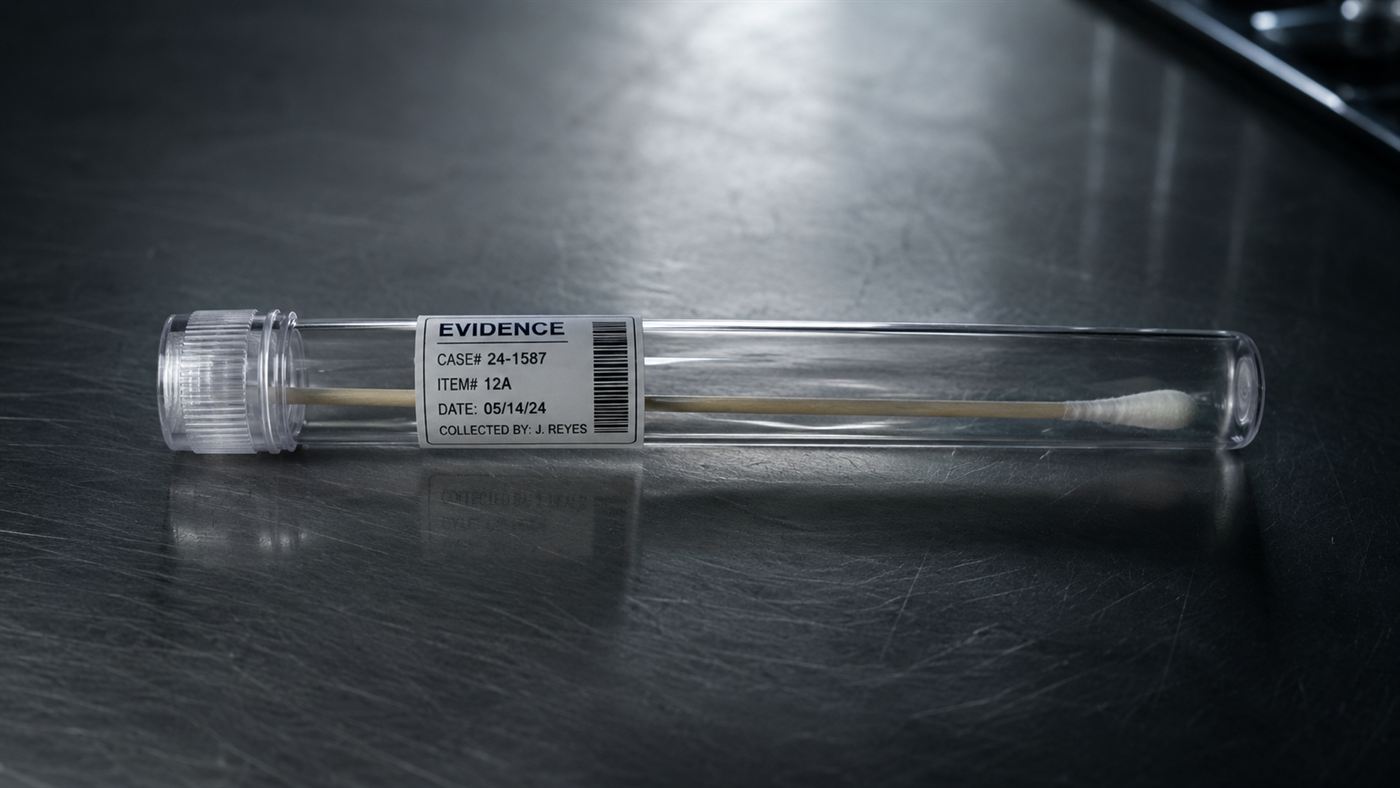
The whole mystery turned on an object as humble as a cotton swab. Illustration: Watts & Wild.
We tend to treat DNA evidence as the final word, a kind of scientific truth that cannot lie. The Phantom of Heilbronn is the most striking proof that even DNA is only as trustworthy as everything it touches on the way to the lab.
It is a detective story with no detective at the centre, and a culprit who turned out to be a mistake.
How the Phantom of Heilbronn fooled police
From the 1990s onward, the same unknown female DNA profile kept appearing at crime scenes scattered across Germany, Austria and France. The Phantom of Heilbronn was linked by that single DNA fingerprint to more than 40 separate crimes, including six murders, making her appear to be one of the most active criminals on the continent.
The trouble was that nothing else fit. The crimes ranged from cold-blooded killings to petty thefts, committed hundreds of miles apart by someone who left no other trace, no witnesses, no pattern, no motive. Investigators dubbed her the Woman Without a Face, posted a huge reward, and poured years of work into finding a master criminal who could be everywhere and yet be no one. They were chasing a ghost, and they did not yet know it.

The clue that broke the case
The whole illusion finally cracked over a single impossible result. Investigators used a swab to take DNA from the burnt body of a man, in order to identify him. The test on the dead man came back showing the phantom's female DNA, a result that simply could not be true, since a man cannot carry that profile.
That contradiction was the thread that unravelled everything. If the female DNA could appear on a sample taken from a man's body, then it was not coming from any suspect at all. It had to be already present on the tool used to collect the evidence. The phantom was not at the crime scenes; she was on the swabs.
A ghost made of cotton swabs
The cotton swabs used by police across the region all came from the same supplier. Investigators traced the mysterious DNA to a woman who worked at the factory that produced the swabs, whose skin cells had contaminated them during manufacturing.
The swabs were sterile, meaning free of bacteria, but no one had thought to make them free of human DNA. As this innocent factory worker packed them, she left tiny traces of her own genetic material behind. Every time an officer dabbed one of those swabs at a crime scene, they were unknowingly stamping her DNA onto the evidence. The most wanted woman in Europe had committed no crime; she had simply done her job on a production line.

Who was the Phantom of Heilbronn?
In the simplest terms, she was a contamination given a personality. The Phantom of Heilbronn was not a criminal at all, but a single stray DNA profile that investigators mistook for a person because it kept appearing where they looked.
That is what makes the case so unsettling. For years, intelligent and careful people built an entire theory of a phantom super-criminal around one piece of evidence they trusted completely. The fault was not in the DNA itself, which was read correctly every time, but in the unexamined assumption that it could only have arrived at the scene with a suspect.
How was the Phantom of Heilbronn case solved?
By following one impossible result to its logical end. Once a man's body returned a woman's DNA, the only sane explanation was contamination, and the trail led straight back to the factory floor rather than to any criminal.
The affair was a deep embarrassment, but it left something valuable behind. It pushed the forensic world to demand that swabs and other tools be made not just sterile but certified free of human DNA, a standard that did not formally exist before. One honest and sobering point remains, though: a real police officer was genuinely murdered in Heilbronn, and the phantom hunt sent that investigation chasing a person who never existed, a reminder that a scientific mistake can carry a very human cost.
The most hunted criminal in Europe turned out to be a stray trace of skin from a factory worker who never broke a law in her life. If even DNA can be fooled this completely, how much of the certainty we place in science is really certainty about the things that science touches? Tell us what you think in the comments.
Related reading: the Somerton Man, an unidentified body whose case waited decades for DNA to give it a name, or cold fusion, the 1989 discovery that turned out to be one of science's most famous mistakes. See also the body farm, where donated bodies taught forensic science how to read time of death.