Liquid air energy storage turns spare electricity into a tank of air chilled to minus 196 degrees, then lets it boil back to power a turbine when the grid runs short
How do you store electricity without lithium or a mountain? Liquid air energy storage cools air until it turns to liquid at minus 196 degrees, keeps it in a tank, and lets it boil back into gas to spin a turbine on demand. The idea began in a British garden shed.
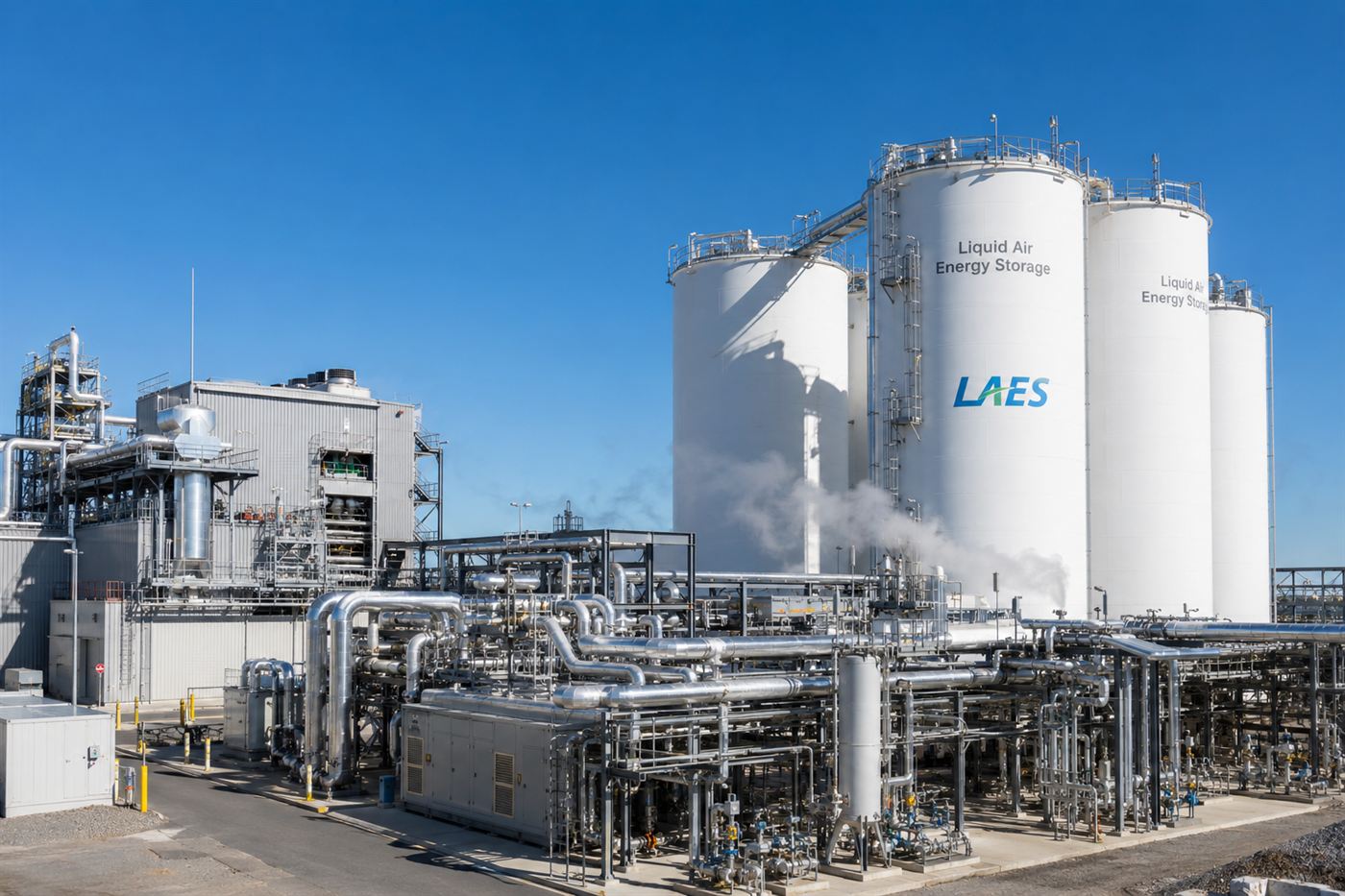
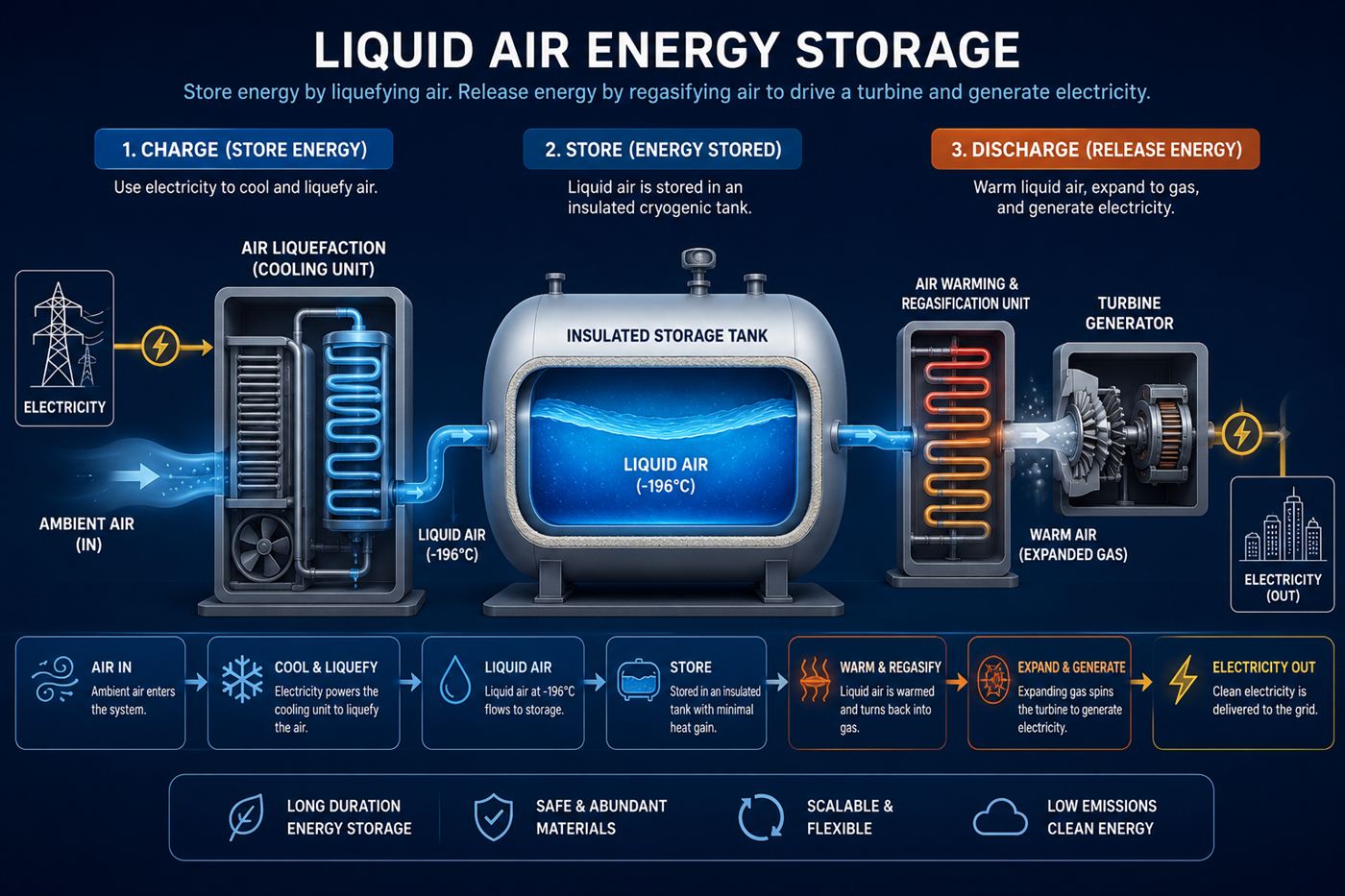
A liquid air energy storage plant keeps its energy as super-cold liquid air in insulated tanks. Illustration: Watts & Wild.
Liquid air energy storage solves an awkward problem with a strange answer. As the world fills its grids with wind and solar power, it needs cheap ways to store electricity for the hours when the wind drops and the sun sets. Batteries are good for short bursts but rely on scarce materials; pumped hydro needs the right mountain and reservoir; compressed air needs the right underground cavern. This technology needs none of those things. It needs only air, a way to make it very cold, and a tank to keep it in.
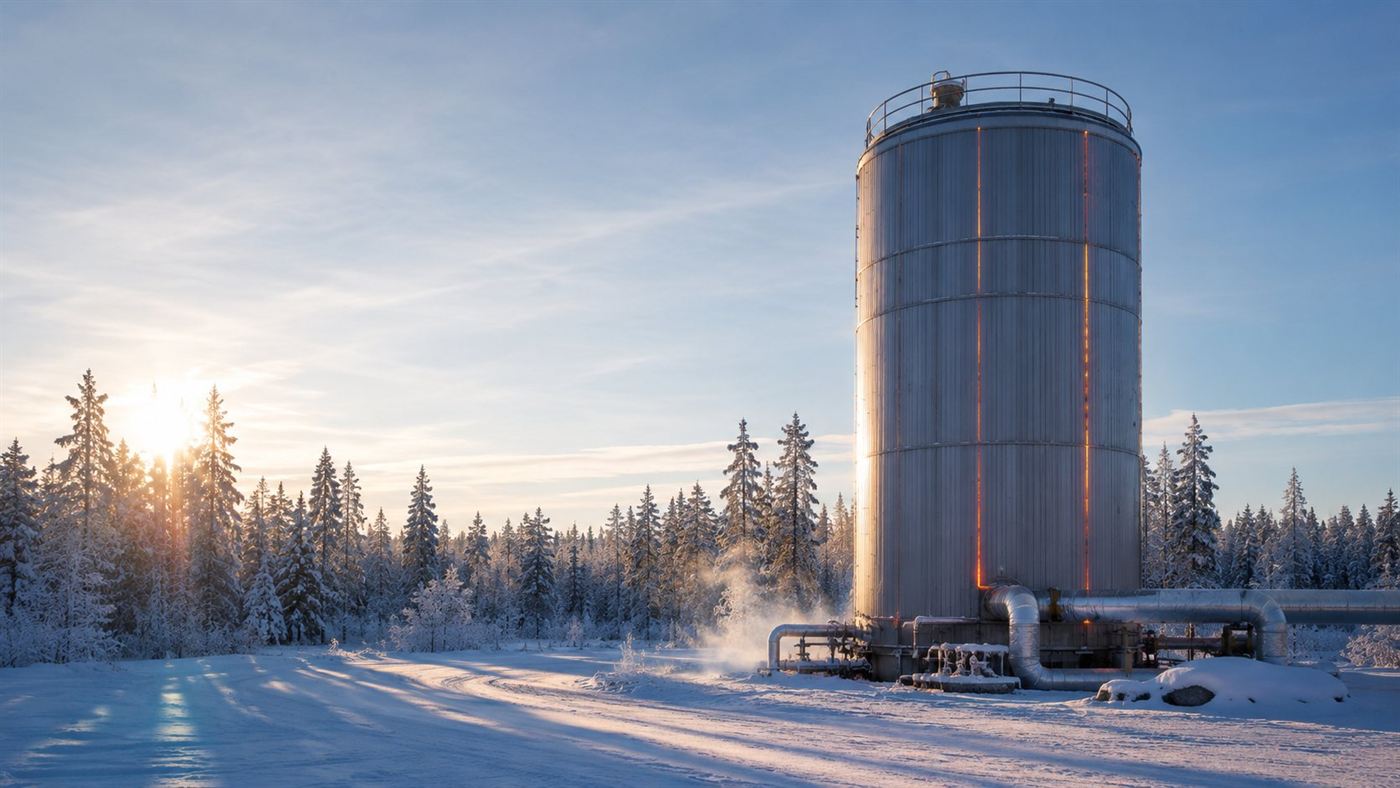
The trick is to turn ordinary air into a liquid and store it. As the developer Highview Power describes the process, surplus electricity is used to chill air to around minus 196 degrees Celsius, at which point it condenses into a liquid that takes up a tiny fraction of its former volume, and that liquid waits, quietly, in an insulated tank until the power is needed again.
What is liquid air energy storage? Liquid air energy storage cools air to minus 196 degrees until it becomes a liquid, then stores it in insulated tanks. When electricity is needed, the liquid is warmed, expands about 700 times back into gas, and drives a turbine. It uses only air, with no rare materials.
Liquid air energy storage, a battery made of air
The appeal of liquid air energy storage is that it sidesteps the bottlenecks of the alternatives. Air is free, infinite and everywhere, so a plant can be built wherever it is needed rather than wherever geology allows. The main pieces of equipment, air liquefiers, insulated tanks and turbines, are all mature industrial technology that has been used for decades to handle gases like nitrogen and oxygen. There is no lithium, no cobalt, no rare earth, and nothing that wears out the way a chemical battery does.
That makes it especially interesting for what engineers call long-duration storage: holding a large amount of energy for many hours, or even days, to ride out a long calm spell or a dark winter evening, the job that ordinary batteries find hardest and most expensive. A close cousin skips the deep freeze and simply squeezes the air instead, in compressed air energy storage.
Freezing the sky into a liquid
The charging half of liquid air energy storage is essentially industrial refrigeration on a grand scale. When there is spare, cheap electricity on the grid, the plant uses it to run compressors and coolers that strip the heat out of ordinary air until, at about minus 196 degrees, it gives up and turns to liquid. In that state it is dramatically denser than gas, shrinking to something like one seven-hundredth of its volume, so a great deal of air can be held as a manageable pool of cold liquid in a tank.
Those tanks are not exotic. The same kind of insulated, low-pressure vessels already store liquid nitrogen and other cryogenic fluids in industry around the world. The plant simply fills them when power is cheap and plentiful, and waits.
Letting it boil to make power
Getting the energy back is where the drama happens. When the grid needs electricity, the plant pumps the liquid air out of the tank and warms it, using nothing more exotic than the surrounding air or waste heat from a nearby factory. Freed from the deep cold, the liquid flashes violently back into gas, expanding around 700 times in volume, and that sudden, forceful expansion is aimed through a turbine, spinning a generator and pouring electricity back into the grid.
There is no flame and no fuel burned anywhere in the cycle, which is the quiet beauty of liquid air energy storage. The only thing that has happened is that air was squeezed into a liquid using surplus power, and then allowed to become air again, doing useful work on the way out.
The inventor in the garden shed
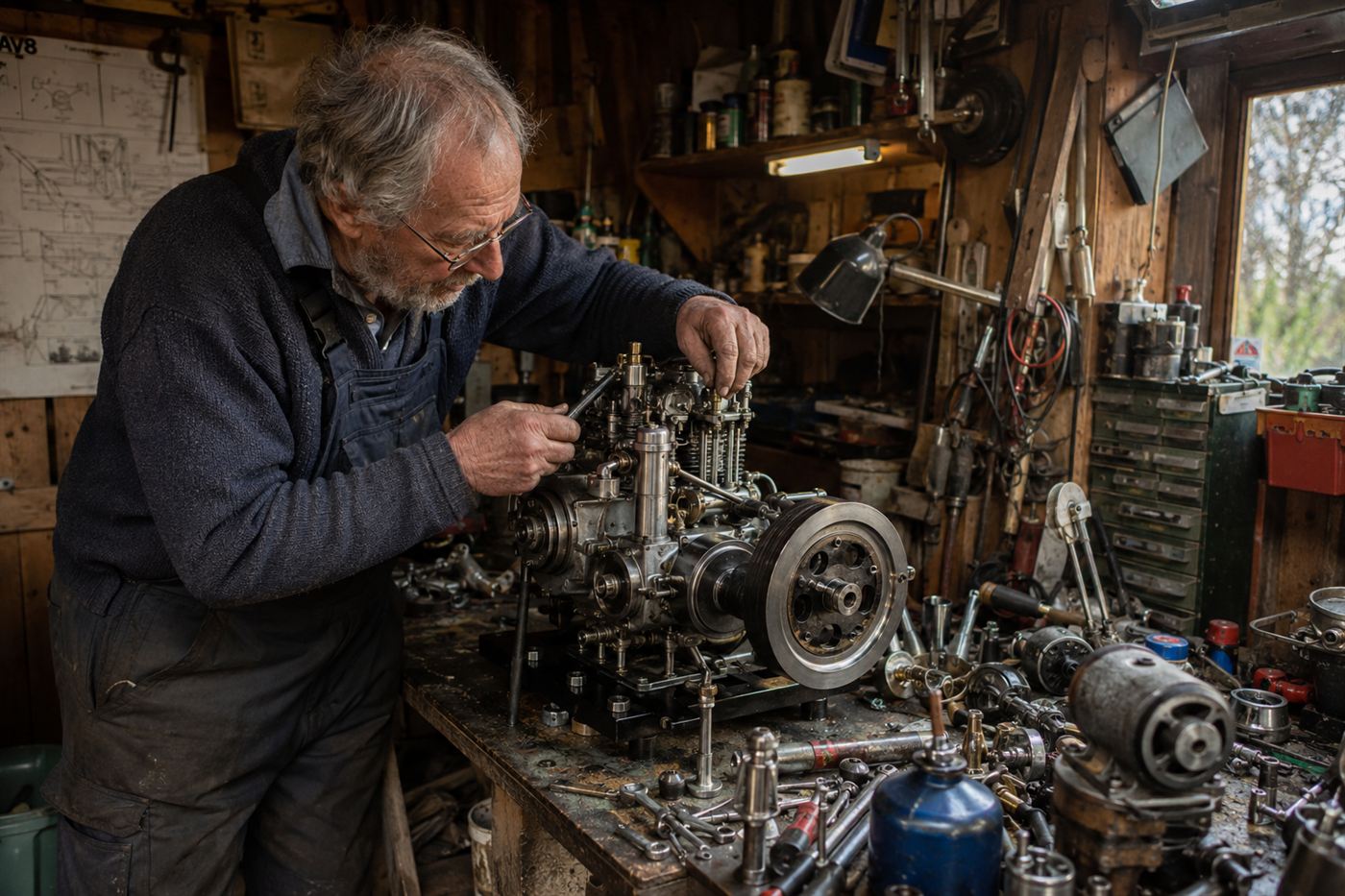
For all its industrial scale, the idea behind liquid air energy storage has wonderfully humble roots. It grew from the work of Peter Dearman, a self-taught British inventor who tinkered for years in his garden shed in Hertfordshire on the notion of an engine that could run on liquid air. He was not a professor or a corporate research lab; he was a backyard experimenter convinced that cold air could be made to do work, and he built engines to prove it.
His concept was eventually taken up and developed with the University of Leeds and commercialised by Highview Power, carrying an idea from a shed bench all the way to the electricity grid. It is a reminder that serious energy technology does not always begin in a gleaming laboratory; sometimes it begins with one stubborn person and a workshop.
From a shed to the Manchester grid
That journey has reached real infrastructure. Highview Power is building a commercial-scale liquid air energy storage plant at Carrington, near Manchester, billed as the largest of its kind. When complete it is designed to hold around 300 megawatt-hours of energy and deliver 50 megawatts of power for about six hours, enough to support on the order of half a million homes through an evening peak. Smaller pilot plants came before it, but Carrington is meant to show the technology working at the scale a modern grid actually needs.
The honest catch
The honest weakness of liquid air energy storage is efficiency. Standing alone, it returns only about 60 percent of the electricity you put in; the rest is lost as heat and cold along the way, which is poorer than a lithium battery, that gives back around 90 percent, or pumped hydro at roughly 80. The figure climbs above 70 percent when the plant can borrow waste heat or cold from a neighbouring industrial site, but it will never be the most efficient option for quick, frequent cycling.
Where it earns its place is in the long game. For storing large amounts of energy over many hours, using only cheap, endless air and ordinary industrial kit, with no scarce metals and a plant you can build almost anywhere, a slightly lower efficiency is often a price worth paying. Liquid air energy storage is still young and largely unproven at the very largest scale, but the principle is sound, and turning the air itself into a battery is exactly the kind of plain, sturdy idea a renewable grid is going to need.
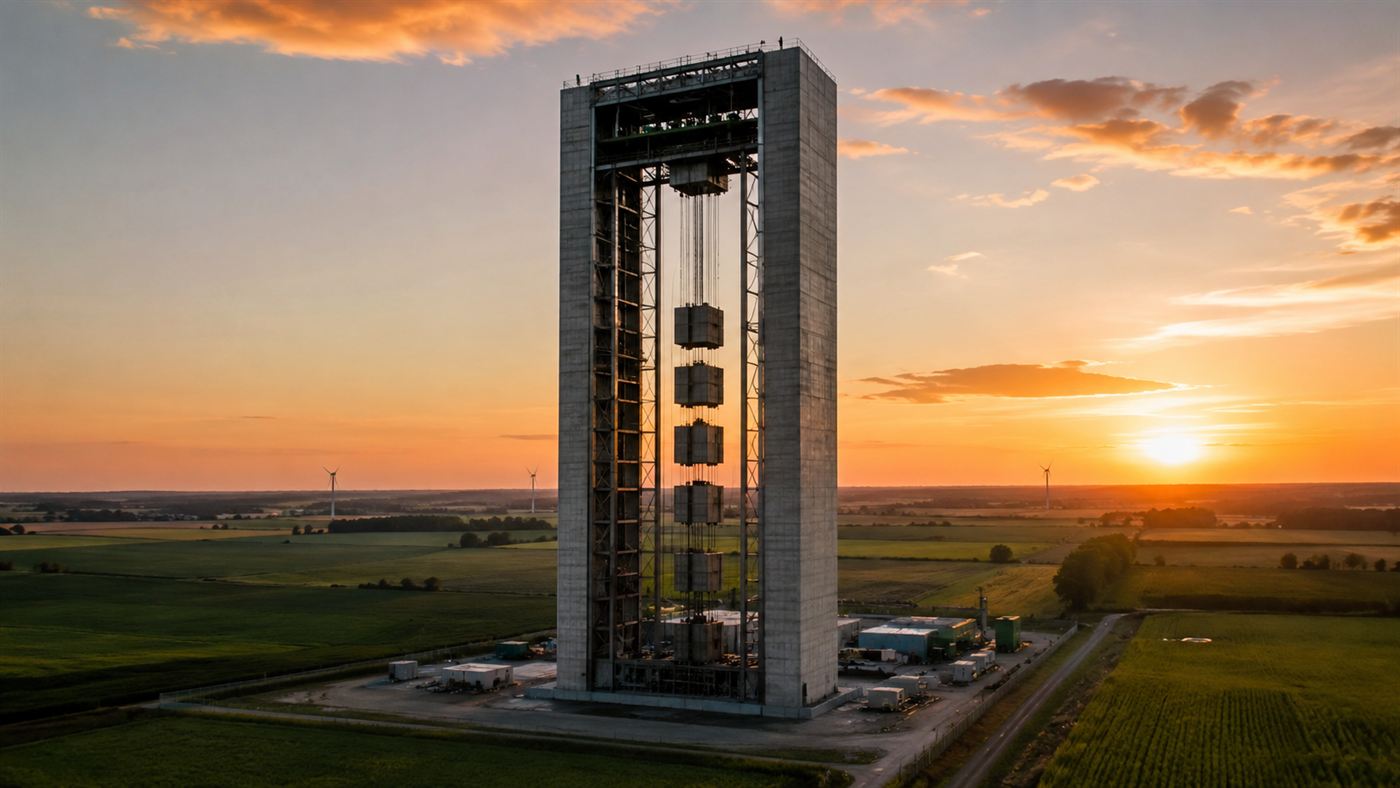
A grid battery that stores power as a tank of liquid air, dreamed up by a man in a garden shed. Would you rather store the grid's spare energy as cold air, as rust, or as weights on a tower? Tell us in the comments.
Related reading: The iron-air battery that stores power for 100 hours by letting metal rust.