The swinging weight that let people watch the Earth turn
Everyone in 1851 knew the Earth went around the Sun and spun on its axis. But knowing it and seeing it are different things, and no one had ever pointed at the ground and said, look, it is moving right now. Then a Frenchman hung a heavy ball from a dome in Paris, set it swinging, and let the crowd watch the floor turn beneath it. The Foucault pendulum made the spinning of the Earth visible for the first time.

A heavy ball on a long wire, and the whole turning planet for an audience. Illustration: Watts & Wild.
It is one of those rare experiments that needs no telescope, no maths, and no faith in an expert. You simply stand and watch, and over the minutes the evidence builds in front of you. What the pendulum reveals is not the ball moving strangely, but the ground you are standing on quietly rotating into a new position.
And the man who staged it was not a famous astronomer or a professor at all, but a restless tinkerer who had walked away from a career in medicine.
A self-taught showman of science
Jean Bernard Leon Foucault had trained to be a doctor, then abandoned it, reportedly because he could not stand the sight of blood. He drifted into photography and physics, learning by doing rather than through the grand institutions. Foucault was a gifted experimenter who would go on to measure the speed of light and invent the gyroscope, but the academic establishment never quite took the outsider seriously.
That is part of what makes his pendulum so satisfying. With no fancy theory of his own, he found a way to demonstrate one of the deepest facts about our world using little more than a wire, a weight, and a patient crowd. He had the backing of the astronomer Francois Arago, who let him try it at the Paris Observatory before the famous public version.
How the Foucault pendulum proved the Earth turns
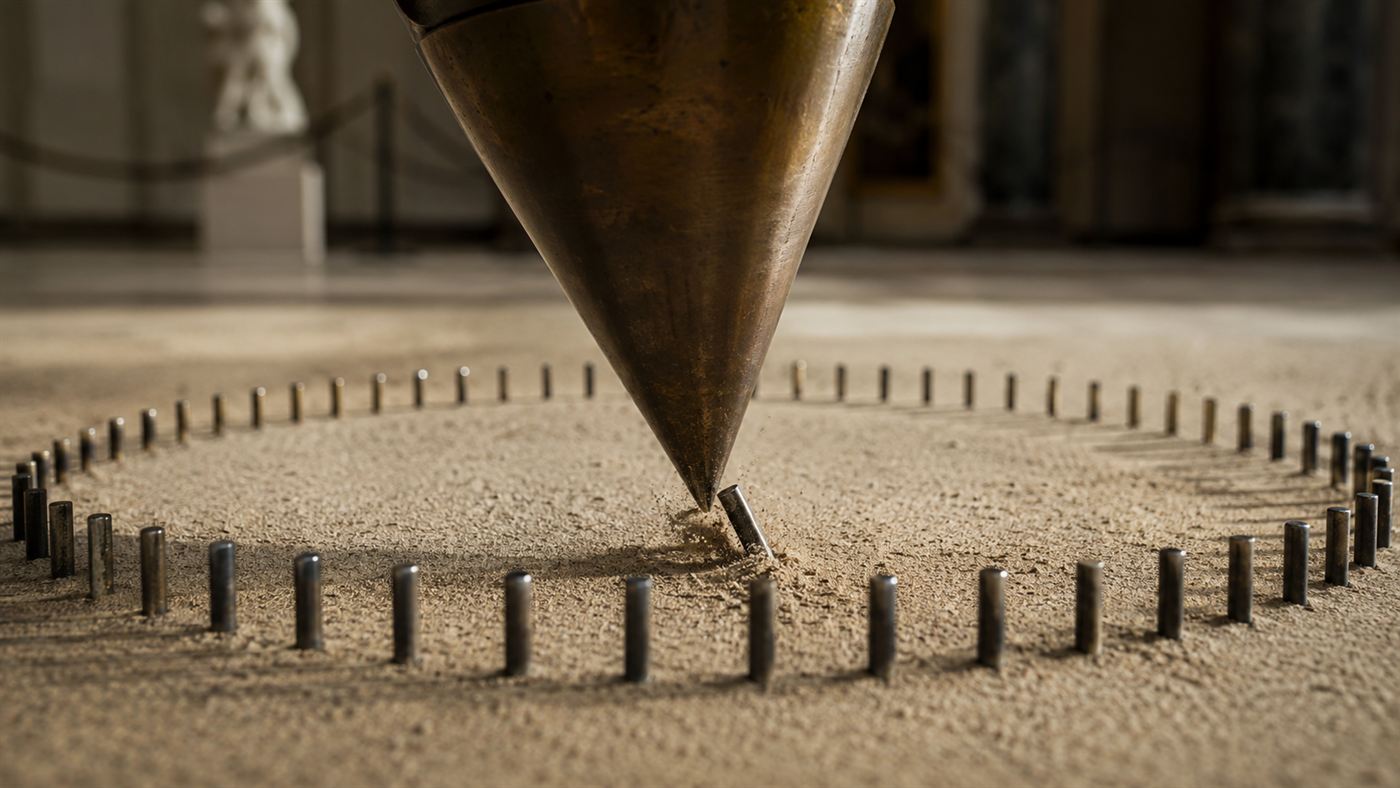
On 3 February 1851 Foucault took his demonstration to the grandest stage he could find, the soaring dome of the Pantheon in Paris. He hung a 28-kilogram brass-covered ball on a wire 67 metres long, set it swinging in a long slow arc, and fixed a pointer to its base that scratched a line in sand spread on the floor.
At first the pointer simply traced the same line back and forth. But as the minutes passed, the line began to shift, swinging slowly clockwise across the sand. The pendulum was not changing direction; it could not, with nothing pushing it sideways. Instead the floor, the building, and all of Paris were turning underneath it. People could stand there and watch, mark by mark, the rotation of the planet they lived on.
Why the floor seems to rotate
The secret is that a swinging pendulum tries to keep its plane of motion fixed in space, pointing the same way relative to the distant stars. As the Earth rotates beneath that fixed swing, observers on the ground see the direction of the swing creep around, when in truth it is they who are being carried around.
How fast the swing appears to turn depends on where you are. At the North or South Pole, the pendulum would complete a full circle in 24 hours, exactly matching the planet. At Paris, set well away from the pole, it takes about 31.8 hours, drifting around some 11 degrees every hour. Right on the equator, strangely, the effect vanishes entirely and the swing never turns at all. The pendulum does not just prove the Earth rotates; it quietly measures your latitude at the same time.

What does a Foucault pendulum prove?
It proves, simply and directly, that the Earth turns. A Foucault pendulum holds its swing in a fixed plane while the planet rotates under it, so the apparent drift of the swing is visible, on-the-ground evidence that the ground itself is moving.
It is worth being fair about what was new. By 1851 scientists had long accepted that the Earth rotated, from the work of Copernicus, Galileo, and Newton. What no one had managed before was a plain, repeatable demonstration you could see with your own eyes in a single afternoon, without looking at the sky. Foucault gave the rotation of the Earth a form that anyone could witness.
How long does a Foucault pendulum take to rotate?
In Paris, about a day and a third. The swing of the original Pantheon pendulum turns a full circle in roughly 31.8 hours, a little over 11 degrees an hour, because of the city's distance from the pole.
That slow, stately pace is part of the magic. You cannot really watch the planet move from moment to moment, but you can come back after lunch and see that the swing has shifted, undeniably, while you were away. It is one of the few experiments where the apparatus is humble, the result is profound, and the only thing you truly need to bring is a little patience.
A wire, a weight, and a floor were all it took to let people watch their planet spin. What other huge truths are hiding in plain sight, waiting for someone to find the simple way to show them? Tell us what you think in the comments.
Related reading: the Antikythera mechanism, a geared computer built two thousand years before its time, and the Therac-25, the radiation machine whose software bug killed its patients.