An immigrant laborer spent 33 years building soaring towers in his Los Angeles backyard with no plans and no help, and when the city tried to tear them down they refused to fall
He was a small, quiet man who worked construction by day and came home to build something no one had asked for. Over three decades, with hand tools and other people's garbage, he raised a forest of glittering spires nearly ten stories tall. Then he handed over the keys and walked away without looking back.
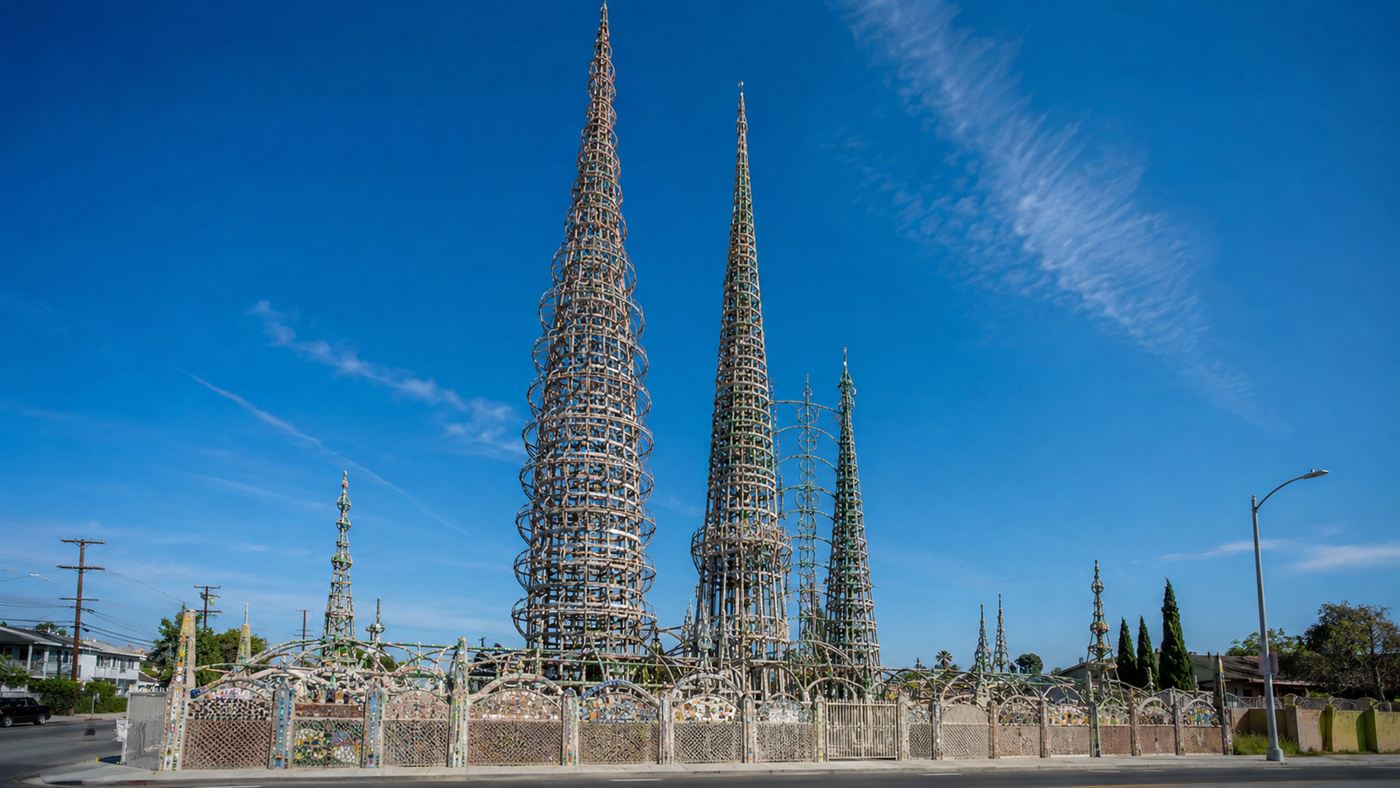
The Watts Towers rise nearly 100 feet, built by one man with no machinery. Illustration: Watts & Wild.
In a working-class neighborhood of Los Angeles stands one of the strangest and most beloved landmarks in America: a cluster of seventeen lacy, soaring towers, the tallest reaching almost 100 feet, all wrapped in a glittering skin of found objects: broken tile, seashells, bottle glass and pottery. They are the Watts Towers, and the most astonishing thing about them is that a single ordinary man built them alone.
That man was Simon Rodia, an Italian immigrant and tile mason, born Sabato, with no training as an architect or engineer. Between 1921 and 1954 he turned his small triangular lot into a work of art so ambitious that, when the city later tried to condemn it, the towers had to survive a literal trial of strength to keep standing.
The short version: Simon Rodia, an immigrant laborer, spent 33 years single-handedly building the Watts Towers in Los Angeles from scrap steel and found objects. He gave the property away in 1955 and left. When the city condemned the towers as unsafe, a 1959 load test proved they could not be pulled down.
Thirty-three years, one pair of hands
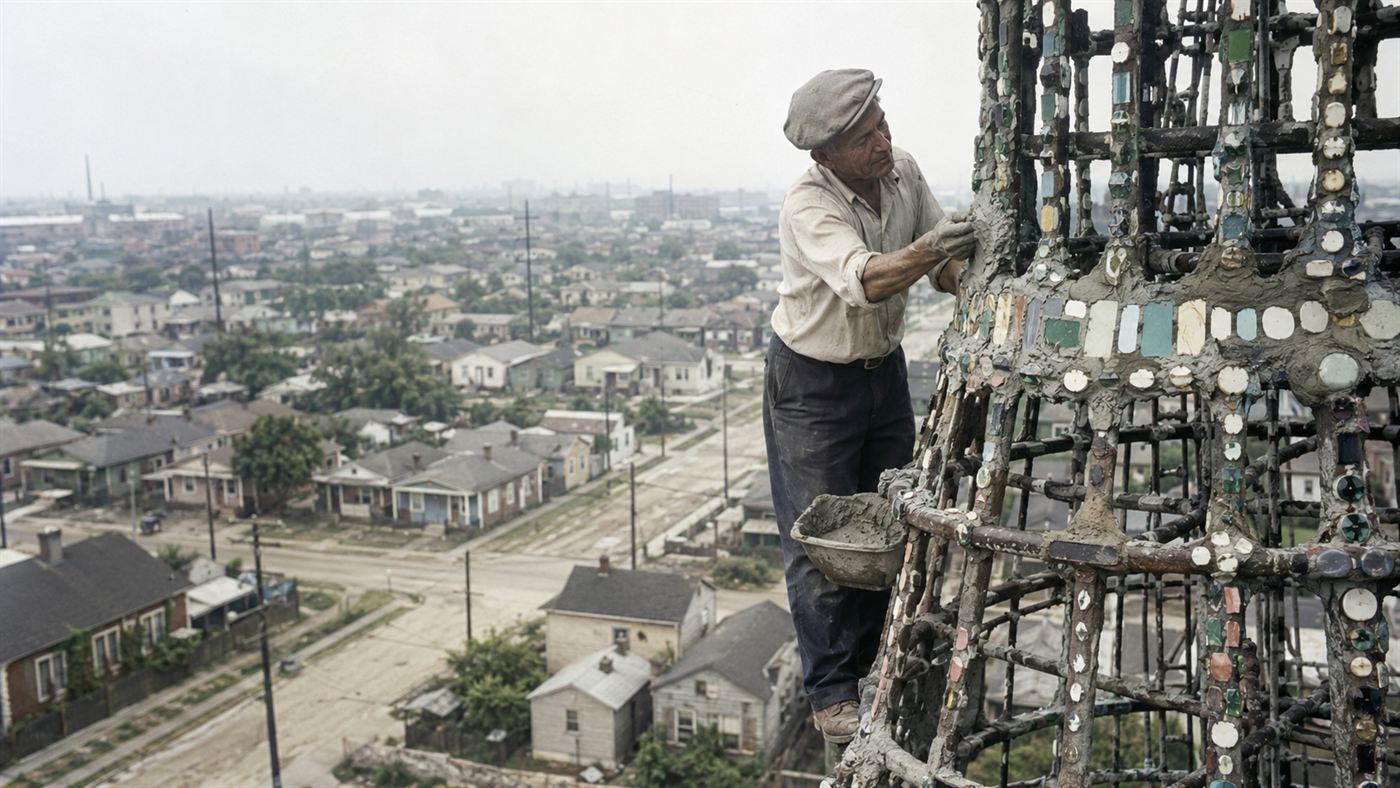
Simon Rodia had no grand plan on paper. He simply started building in 1921 and did not stop for more than three decades, working evenings and weekends after his day jobs. He used no scaffolding, no bolts, no rivets and no welds. Instead he climbed his own growing structure, wrapping steel rods in wire mesh and coating them in mortar by hand.
His materials were whatever the world threw away. He bent salvaged rebar into shape by wedging it against the nearby railroad tracks, and he pressed a mosaic of broken pottery, green 7 Up bottles, seashells and cracked tiles into the wet cement. What looks like delicate lacework from a distance is, up close, a lifetime of patiently reused trash.
Why would a man build this for nothing?
Rodia never gave a tidy explanation, and that is part of the legend. His most quoted line is simply, "I had in mind to do something big, and I did it." He called the work Nuestro Pueblo, "our town," and seems to have built it purely out of a need to make something that would last, with no buyer, no commission and no audience in mind.
Then, just as mysteriously, he was done. In 1955, an aging Rodia signed the property over to a neighbor, walked away from the towers that had consumed his life, and moved to northern California. He never returned to see them, and he died in 1965, having left behind one of the great acts of solitary creation in American history.
The day the city tried to pull them down
Left untended, the towers fell under suspicion. After a fire nearby in the mid-1950s, the city of Los Angeles declared the strange structures a hazard and ordered them demolished. To officials, an unpermitted, self-taught tower nearly 100 feet tall looked like a disaster waiting to happen, and the bulldozers were lined up.
Preservationists fought back and proposed a load test. On October 10, 1959, a crane was hooked to one of the towers to try to pull it over, applying thousands of pounds of steady, sideways force. The plan was simple: if the tower failed, it deserved to come down. If it held, the city would have to leave Rodia's work alone.
How the Watts Towers won a test of strength
The crane pulled with the force of 10,000 pounds, and the tower did not so much as sway out of true. In one of the great David-and-Goliath moments in preservation history, it was the testing equipment that gave out first, not the hand-built spire. The self-taught mason's engineering had beaten the professionals sent to condemn it.
The demolition order was dropped. The Watts Towers went on to become a National Historic Landmark, a symbol of the Watts neighborhood, and a place of pilgrimage for artists and tourists. They even rode out the violent 1994 Northridge earthquake with only minor damage. They still stand on their triangle of land decades after their maker walked away.

The honest catch
It is a perfect underdog story, and mostly a true one, but it is worth resisting the myth of the lone genius who needed nothing. Rodia was a skilled tile mason by trade, so he was not quite the untrained amateur the tale sometimes suggests, and the towers have needed careful, expensive conservation ever since to survive weather, cracking and time. Keeping them up has taken a small army.
There is also a quieter loss inside the triumph. Rodia never explained his masterpiece and never came back to enjoy it, so the meaning of Nuestro Pueblo left with him. We saved the towers, but not the answer to why one man spent a third of his life building them, and that mystery is now as permanent as the steel.
One man turned scrap metal and broken bottles into a masterpiece, then vanished without telling anyone why, and the city could not even pull it down. What would you spend 33 years building if you never expected anyone to pay you for it? Tell us in the comments.
Related reading: Coral Castle, the mysterious stone monument one man carved alone in Florida. See also the Winchester Mystery House, the mansion a grieving widow built for 38 years without stopping.