China opened the world's longest expressway tunnel on December 26, 2025, a 22.13 kilometer bore through the Tianshan Mountains that cuts an hours-long crossing to about 20 minutes
For generations the Tianshan Mountains were a wall splitting Xinjiang into a northern half and a southern half, forcing travelers onto a long, weather-exposed detour. On December 26, 2025, China opened a 22.13 kilometer tunnel through them, the longest expressway tunnel on Earth, turning that crossing into a 20-minute drive.
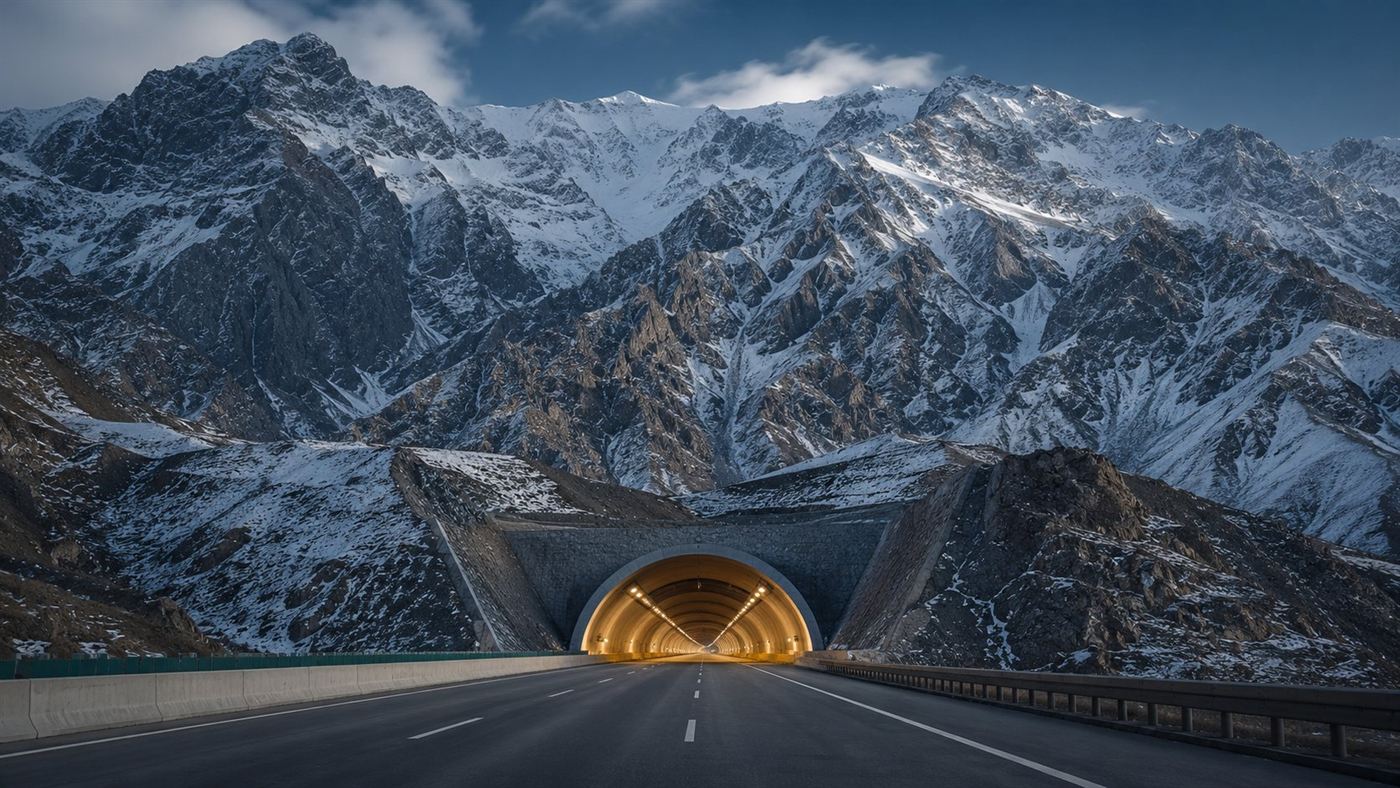
The Tianshan Shengli Tunnel runs 22.13 kilometers under the Tianshan range in Xinjiang. Illustration: Watts & Wild.
For most of recorded history, the Tianshan range did one stubborn thing to anyone trying to cross it: it slowed them down. The mountains run east to west across Xinjiang, splitting the region into a northern half around the capital Urumqi and a southern half toward Korla, and the only way through was a winding, weather-exposed road that swallowed several hours and shut down in bad cold. But now that same crossing takes about 20 minutes, because the road no longer goes over the mountains. It goes straight through them.
On December 26, 2025, China opened the Tianshan Shengli Tunnel, a 22.13 kilometer bore that Xinhua reports is now officially the world's longest expressway tunnel. It is the centerpiece of the G0711 Urumqi to Yuli Expressway, which opened the same day, and according to the South China Morning Post, it cuts the Urumqi to Korla journey from more than seven hours to about three and a half. A drive that once meant a full day of mountain switchbacks is now an afternoon.
A mountain wall, finally pierced
The Tianshan, or "Celestial Mountains," are not a minor obstacle. They stretch for thousands of kilometers and carry permanent snow at altitude, and for the people of Xinjiang they have always been the line that separates north from south. Trade, travel, and the movement of goods between the two halves of the region had to climb that line and then descend it again, a journey exposed to wind, ice, and the kind of cold that closes roads for days.
The new tunnel erases the climb entirely. China Daily describes it as the world's longest expressway tunnel crossing the Tianshan Mountains, and the geography of that crossing is what makes the 20-minute figure so striking. Where drivers once spent hours gaining and losing thousands of meters of elevation, they now hold a steady line underground and emerge on the other side of the range before they have finished a podcast episode.
The broader effect is on the whole region. By halving the Urumqi to Korla trip, the tunnel knits the northern and southern economies of Xinjiang closer together, and Chinese state media frames it as a piece of north to south integration that also strengthens links reaching toward Central Asia. It is, in their telling, as much a corridor as a tunnel.
Three tubes instead of one
What looks from outside like a single tunnel is actually three parallel bores working together. The design places two outer main traffic tubes on either side of a central service tunnel about 8.4 meters across, and that middle tube does the unglamorous but life-saving work: it is the emergency and rescue channel, the place crews and stranded drivers retreat to if something goes wrong in the traffic bores.
That central service tunnel carries a record of its own. According to the trade journal Tunnels and Tunnelling, the middle bore was driven by a tunnel boring machine, the first such use in a Chinese highway tunnel. Most of China's long road tunnels have been blasted and dug by conventional drill-and-blast methods, so threading a TBM down the spine of this one was a deliberate bet on a faster, more controlled way to cut rock.
The three-tube layout is not just about safety theater. With a service tunnel running the full length alongside the traffic tubes, ventilation, maintenance, and rescue all have a dedicated path that never interferes with the cars overhead. In a 22.13 kilometer tunnel, where a driver is never less than several kilometers from daylight, that redundancy is the difference between an inconvenience and a disaster.
The machine built for the job
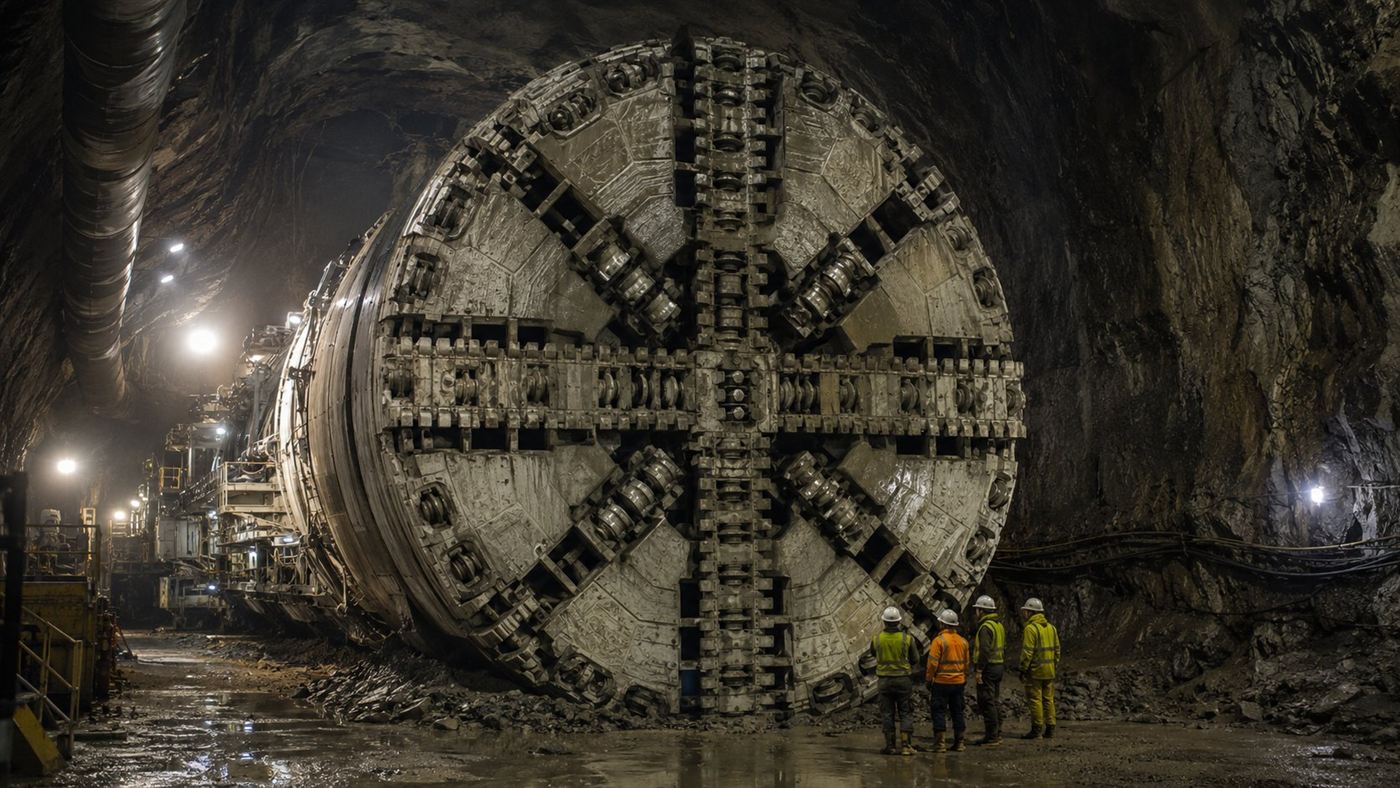
The cutting was done by hardware built specifically for this mountain. China deployed a domestically developed, world-first pressurized hard-rock tunnel boring machine, a class of machine designed to chew through dense rock under high ground stress without losing its grip. Xinhua singles out that pressurized hard-rock TBM as one of the project's headline engineering firsts.
The numbers on the service-tunnel machine alone are hard to picture. It ran more than 280 meters in length, weighed over 2,900 tonnes, and turned a cutterhead about 8.43 meters across, roughly the height of a three-story building rotating against solid rock. A machine that size does not get delivered and switched on; it is assembled underground and inched forward meter by meter for years.
Using a TBM here was a calculated risk. Hard rock and high stress are exactly the conditions where boring machines can jam or break, which is why Chinese tunnelers have leaned on blasting for so long. Pulling it off in the Tianshan, and doing it with a homegrown machine, is the part of the story China's engineers are proudest of.
Four shafts and a breathing system
A tunnel this long cannot be dug from its two ends alone, and it cannot be ventilated from them either. The solution was to sink four deep vertical shafts straight down from the surface to meet the tunnel below, the deepest of them plunging roughly 700 meters. Tunnels and Tunnelling notes those four shafts at around 700 meters deep, and officials say the project holds the record for the deepest vertical shaft of any highway tunnel.
Those shafts do double duty. While the tunnel was under construction, they let crews excavate from multiple points at once instead of only the two portals, effectively turning one long dig into several shorter ones working toward each other. Now that the road is open, the same shafts act as the tunnel's "respiratory system," pulling fresh air down and pushing exhaust up across the full 22.13 kilometers.
The depths involved are genuinely extreme. The tunnel reaches a maximum burial depth of 1,112.2 meters below the surface, meaning that at its deepest point, more than a kilometer of mountain sits directly overhead. Combine that with a 700 meter ventilation shaft and the vertical scale of the project starts to rival its length.
Built in some of Earth's harshest ground
The conditions the crews fought were brutal even by mega-project standards. Construction began in April 2020 at an altitude near 3,000 meters, where the air is thin and temperatures can fall to about minus 42 degrees Celsius. Working in that cold, at that height, for years on end is a physical ordeal before any rock is even cut.
The geology was worse than the weather. Engineers had to drive the tunnel through 16 geological fault zones, under high ground stress and in an area of high seismic intensity, the kind of unstable, fractured ground that can crush or flood a tunnel as it is being dug. Xinhua lists those 16 fault zones and the 1,112.2 meter maximum burial depth among the central challenges of the build.
Despite all of it, the timeline held. Wikipedia records that construction started in April 2020 and the main tunneling breakthrough was completed on December 30, 2024, with the road opening to traffic almost exactly a year later. From first dig to open road, the project ran about five and a half years.
The honest catch
The dramatic "20 minutes" is real, but it deserves a footnote. That figure applies only to the tunnel crossing itself, the stretch where you are actually underground, not to the whole journey. The full Urumqi to Korla trip is still about three to three and a half hours, which is a genuine improvement over the previous seven-plus, but it is not a 20-minute commute.
The sources also disagree slightly on the new travel time. Xinhua puts the shortened Urumqi to Korla trip at about three hours, while SCMP and others say closer to three and a half, which is why the honest figure is a range rather than a single number. It is a small gap, but it is worth naming rather than papering over.
There is a larger caveat too. Almost all of the numbers and the superlative claims, the records, the cost, the engineering firsts, trace back to Chinese state media and the project's own authorities rather than to independent verification, and the geopolitical and Belt-and-Road framing is theirs as well. The tunnel is real and open; the way its significance is described is a story being told by the people who built it.
What 3.8 billion dollars buys
None of this came cheap. The project is estimated to have cost about 26.8 billion yuan, roughly 3.8 billion US dollars, a figure Tunnels and Tunnelling cites alongside the engineering detail. For that money, China bought a permanent shortcut through a mountain range that had blocked easy travel through Xinjiang for as long as people have lived there.
The strategic logic behind the spending is plain in how state media presents it. Chinese outlets frame the tunnel as strengthening north to south integration within Xinjiang and improving links toward Central Asia, the kind of connective infrastructure that fits neatly into the Belt and Road narrative. A faster road between the halves of the region is also a faster road toward the border.
Whatever you make of the framing, the raw achievement stands. A 22.13 kilometer tunnel, three bores, four shafts to a depth of 700 meters, a kilometer of rock overhead, built through 16 fault zones at minus 42 degrees, and finished in five and a half years. The mountains are still there. The wall is not.
A crossing that once ate a whole day now takes about 20 minutes underground, bought with a 22.13 kilometer hole through a mountain range and roughly 3.8 billion dollars. Would you drive 22 kilometers through a tunnel with a kilometer of mountain over your head to save several hours on the surface? Tell us what you think in the comments.
Related reading: China has begun building a 137 billion dollar megadam in the Himalayas.