California just switched on the first US solar panels built over irrigation canals, and covering all 4,000 miles could save 63 billion gallons of water a year
Solar's biggest enemy is land, and farmland is exactly what nobody wants paved in panels. California's answer is to build over the thousands of miles of canals it already owns. The first US pilot just went live, and the statewide math is staggering.
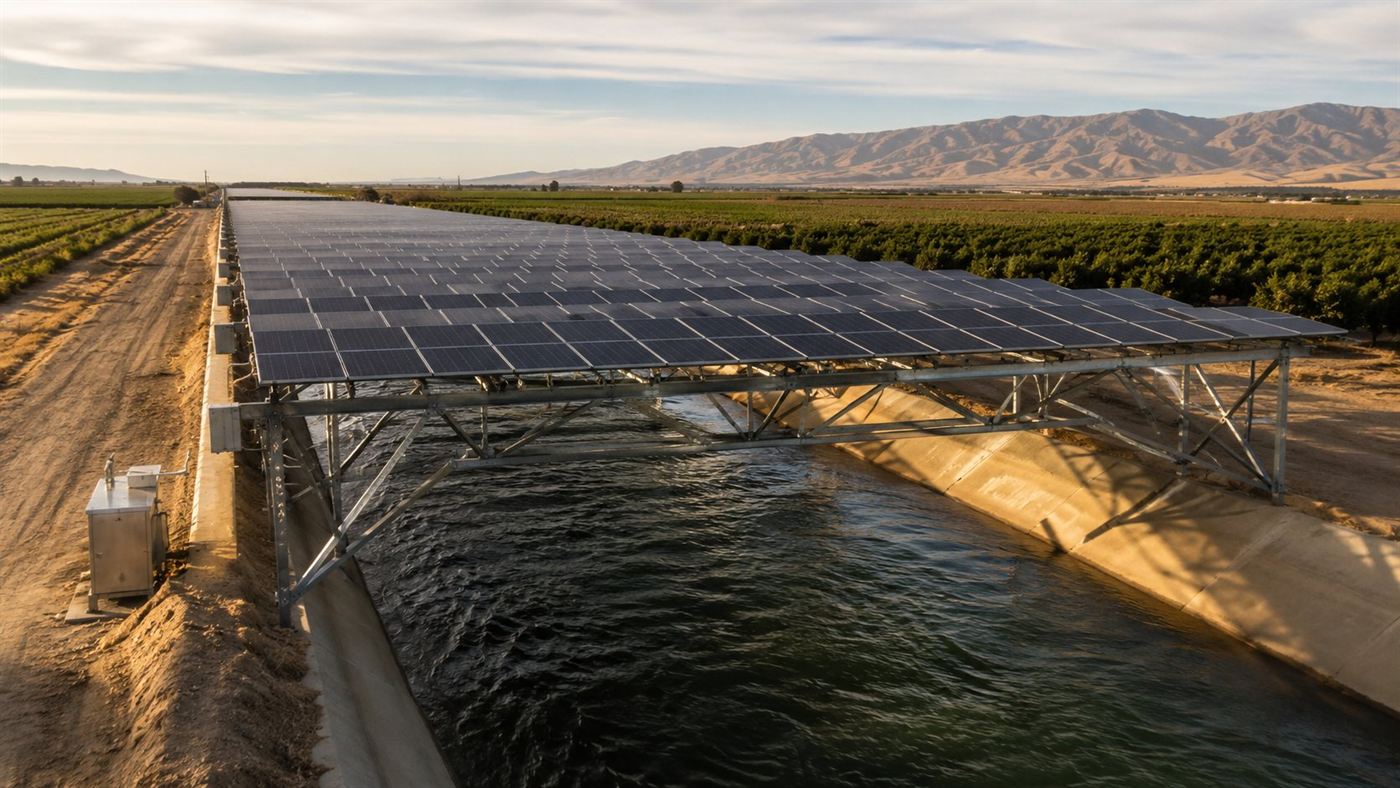
Solar panels span an irrigation canal in California's Central Valley, generating power while shading the water below. Illustration: Watts & Wild.
For years the case against big solar has been the same nag: it eats land, and the flat, sunny land it loves most is farmland. So here is the twist California just made real. On April 29, 2026, Governor Gavin Newsom announced the completion of Project Nexus, the first solar-covered canal in the United States, built over the irrigation canals of the Turlock Irrigation District in the Central Valley.
The pilot is small on its own, a 1.6-megawatt array, enough to power roughly 1,200 homes. But it is a proof of concept for a much larger idea, and the science behind it is what makes the story land. Researchers at UC Merced estimate that covering all of California's roughly 4,000 miles of canals could save up to 63 billion gallons of water a year while generating about 13 gigawatts of solar power. The infrastructure that wastes water in the sun would become the infrastructure that saves it.
Why building over a canal is the clever move
Solar's biggest constraint is land, and farmland is exactly what people fight to keep out of panels. Canals flip the problem on its head. The state already owns thousands of miles of open water corridors that do nothing all day but evaporate under the sun. Build over them and you get clean power on land you never had to buy.
At the same time, the panels shade the water you were losing to evaporation in the first place. It is a rare engineering deal where the same structure solves two problems at once: it generates electricity above and it conserves water below. The thing that was a liability, open water baking in the heat, becomes the asset.
That is the core insight driving Project Nexus, a public-private-academic partnership among the Turlock Irrigation District, the California Department of Water Resources, solar developer Solar AquaGrid, and UC Merced. First announced in February 2022, it was built out across 2025 before the April 2026 completion announcement, making it the first solar-over-canal installation anywhere in the country.
What the pilot actually looks like
This is not a single tidy stretch of panels. As the American Society of Civil Engineers reported, the pilot spans two narrow canals each about 25 feet wide, roughly 1,400 linear feet in total, plus one wide 115-foot-across section running about 300 feet. Together they produce around 1.6 megawatts.
The design is deliberately varied because the whole point is to learn. Narrow spans and wide spans behave differently, cost different amounts, and shade water in different ways, so building both lets researchers measure the real-world co-benefits rather than guess at them. About 1,700 linear feet of canal are covered in total.
The numbers also tell a quieter story about ambition meeting reality. The pilot was scaled back from a planned 8,000 feet to about 1,700 because of cost and constructability. That trimming is itself a finding: it flags exactly where the engineering gets hard and expensive, which is information any future statewide build would need.
The science that started it all
The headline figures everyone quotes do not come from the pilot. They come from a 2021 study by UC Merced and UC Santa Cruz researchers, led by Brandi McKuin and published in the journal Nature Sustainability. The team modeled what would happen if California covered all of its roughly 4,000 miles of canals.
The results were the kind that get politicians' attention. As the University of California summarized, the study estimated up to 63 billion gallons of water saved each year and about 13 gigawatts of new solar capacity. The evaporation reductions were the most striking part, modeled as high as 82% thanks to midday shade and reduced wind across the water surface.
It is worth holding these two scales apart. The 63-billion-gallon and 13-gigawatt numbers are statewide model projections, not measurements from Project Nexus. The pilot itself is the test that tells researchers whether the model holds up when it meets steel, concrete, and real flowing water.
The bonus benefits nobody expected
Power and water savings are the headline, but the shade does more than cut evaporation. By keeping sunlight off the water, the panels curb the growth of aquatic weeds and algae that clog canals, which means less maintenance and lower upkeep costs for the district over time.
The relationship runs both ways. Cooler water flowing beneath the panels can also slightly boost the efficiency of the solar cells above it, because photovoltaics lose performance as they heat up. A canal acts like a long, free cooling channel, and the panels return the favor by shading the water. Each side makes the other work a little better.
Project Nexus also pairs the canal arrays with a regulating reservoir designed to improve the Turlock Irrigation District's water operations, with the potential to save on the order of 10,000 acre-feet of water a year through smarter system management. The solar is the eye-catcher, but the water-operations gains may matter just as much to a district running dry summers.
India did it first, in 2012
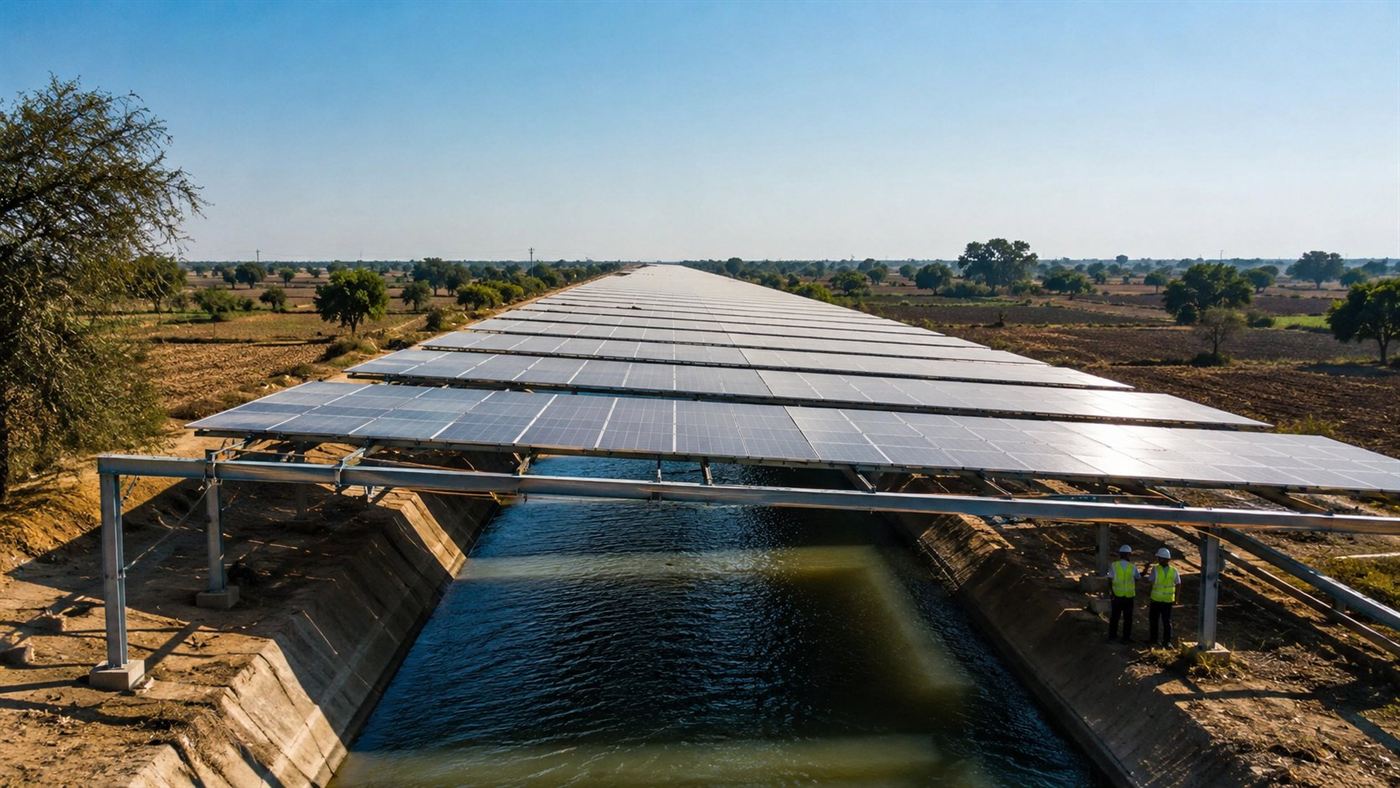
California is the first to do this in the United States, but it is not the first in the world. India got there more than a decade earlier. On April 24, 2012, then-Gujarat Chief Minister Narendra Modi inaugurated a 1 MW canal-top pilot on a Narmada branch canal near Chandrasan village, billed as the world's first canal-top solar plant. It was projected to prevent about 9 million liters of evaporation a year.
The Indian experience also produced hard field data that backs up the California theory. Independent reporting found that panels mounted over canals ran about 10 degrees Celsius cooler than ground-mounted ones, yielding roughly 2.5% better efficiency, and saved on the order of 9 million liters per megawatt per year from evaporation. The cooling and water-saving benefits were not just modeled, they showed up in practice.
So the concept has a real track record. What India never managed was to scale it from a celebrated pilot into a sprawling commercial network, and the reason is the same one that haunts California's project.
The honest catch
It is still more expensive to build than ordinary ground-mounted solar, and there is no getting around that. Spanning a canal needs custom support structures, and the wider the canal, the more the steel and the cost climb. You are paying for engineering that a flat field simply does not require.
India's experience is the cautionary tale. It inaugurated the world's first canal-top plant in 2012 to global fanfare, but the model largely stalled commercially because a 1 MW canal plant cost roughly $2.8 million versus about $2.3 million on land, and grids paid the same rate for power from both. Without subsidies, the math did not pencil out. Good for the environment, the reporting concluded, but not for business.
California is not immune. The $20 million state-funded pilot was itself scaled back from a planned 8,000 feet to about 1,700 because of cost and constructability, and Project Nexus is explicitly a proof of concept to measure benefits, not a finished commercial blueprint. Researchers caution that it is premature to draw firm conclusions on measured evaporation from the pilot, and the headline 63-billion-gallon and 13-gigawatt figures remain statewide projections, not pilot results. Whether solar canals pencil out at scale is exactly the question Project Nexus was built to answer.
A state that fights over every acre of land and every gallon of water may have been sitting on the answer to both the whole time, in the open canals already running through its farmland. Should California race to cover all 4,000 miles of its canals with solar, or wait until the pilot proves the savings are real? Tell us what you think in the comments.
Related reading: inside the world's largest solar farm, where 20,000 sheep keep the grass down.