New York just finished a 111 million dollar living seawall off Staten Island, a 2,400 foot chain of eight stone reefs built to grow oysters and break storm waves
A normal seawall cracks, erodes, and eventually gets torn out. New York just finished a different kind off Staten Island: a 2,400-foot chain of eight stone reefs engineered to be colonized by living oysters that knit the structure together, heal storm damage, and grow taller as the sea rises.
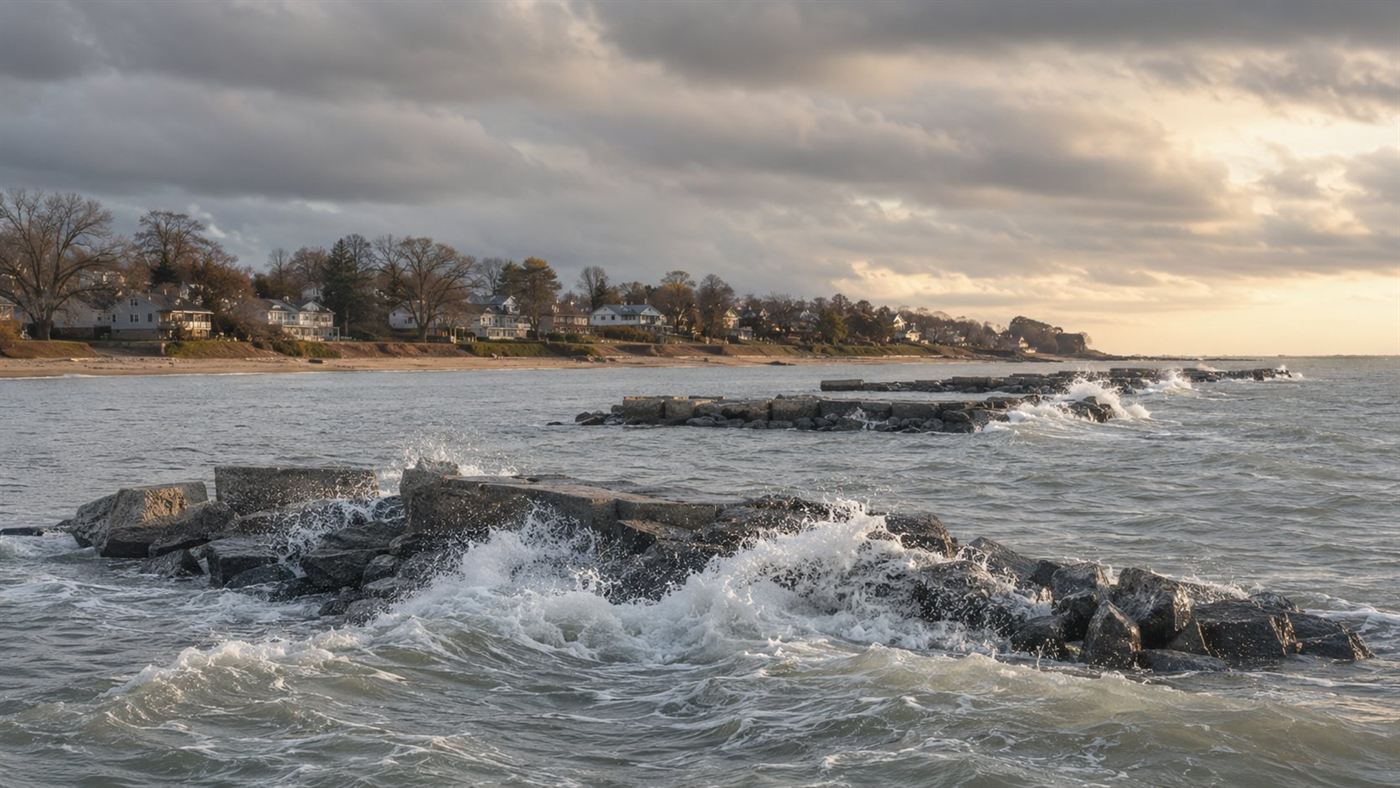
Eight stone-and-concrete reefs sit just offshore, built to be colonized by oysters. Illustration: Watts & Wild.
For most of the last century, the answer to a storm-battered coast was always the same hard idea: pour a wall of concrete and hope it holds. It cracks, it scours the beach in front of it, it pushes wave energy onto the neighbor down the shore, and one day it has to be torn out and rebuilt at enormous cost. So the thing New York finished off Staten Island in October 2024 is worth a second look, because it is a seawall that is supposed to be alive.
On September 27, 2024, the Office of Governor Kathy Hochul announced the completion of the $111 million Living Breakwaters project, a 2,400-foot chain of eight near-shore structures engineered to cut storm waves reaching the coast to below three feet in height. Construction began in August 2021. The reefs are stone and concrete now, but they are designed to be slowly taken over by oysters, a living defense built in direct answer to the storm that nearly drowned this coast, Superstorm Sandy.
Born from the storm that broke the old playbook
Sandy hit New York in October 2012 and exposed how brittle a hardened coastline really is. In the aftermath, the U.S. Department of Housing and Urban Development launched the Rebuild by Design competition in 2013, hunting for ideas that did more than build a taller wall. Living Breakwaters was one of the winners, and it came from a team led by Kate Orff, founding principal of SCAPE Landscape Architecture and a MacArthur genius grant recipient.
Orff's premise inverted the usual logic. Instead of trying to stop the sea with a barrier, the design works with it, slowing waves, trapping sediment, and inviting life back into a harbor that had been scrubbed nearly lifeless. As SCAPE describes the project, the 2,400 linear feet of near-shore breakwaters are made of stone and ecologically enhanced concrete and were built between August 2021 and October 2024 to serve as habitat as much as defense.
The result is not one continuous wall but eight separate segments, each roughly 400 feet long, sitting just offshore of Tottenville on Staten Island's southern tip. The gaps between them are deliberate. Water still moves through, but the storm punch is broken up before it ever reaches the beach.
How a pile of rough rock tames a wave
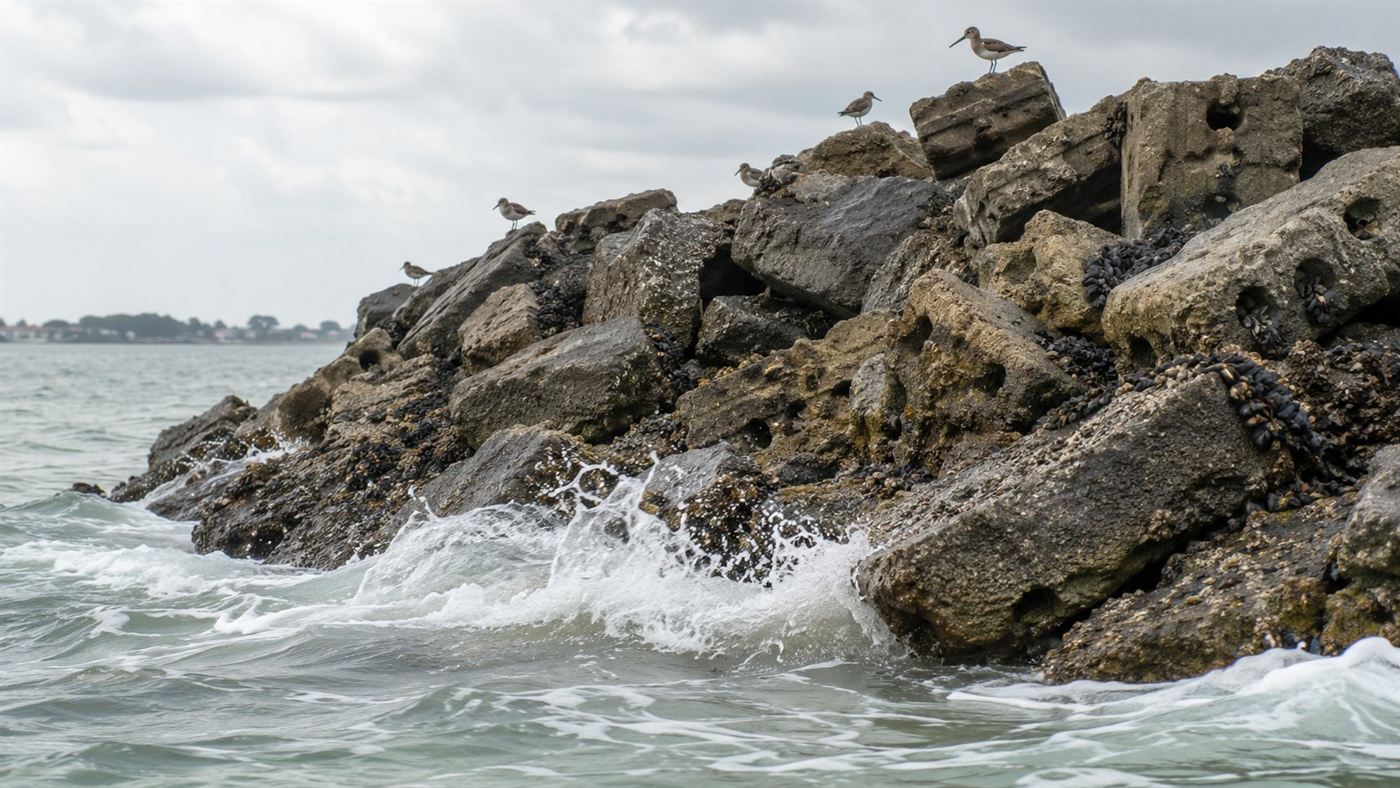
The structures are rubble-mound reefs, not smooth concrete faces. Each has a stone core wrapped in armor stone and topped with ecologically enhanced concrete units supplied by ECOncrete, textured with features the designers call reef ridges and reef streets to give marine life something to grab. That roughness is the whole point. A smooth wall reflects a wave back out to sea and onto its neighbors. A rough, three-dimensional reef forces the wave to break offshore and bleeds its energy away.
The physics shows up clearly in field studies elsewhere. According to NOAA's Naturally Resilient Communities, oyster reefs in the Gulf of Mexico have cut wave energy by 76 to 93 percent, and projects in Mobile Bay, Alabama, recorded wave-energy reductions of 76 to 99 percent and wave-height reductions of 51 to 90 percent at the shore. Sediment that would have washed away instead piles up behind the reef, which can slowly rebuild the beach itself.
The oysters are the maintenance crew
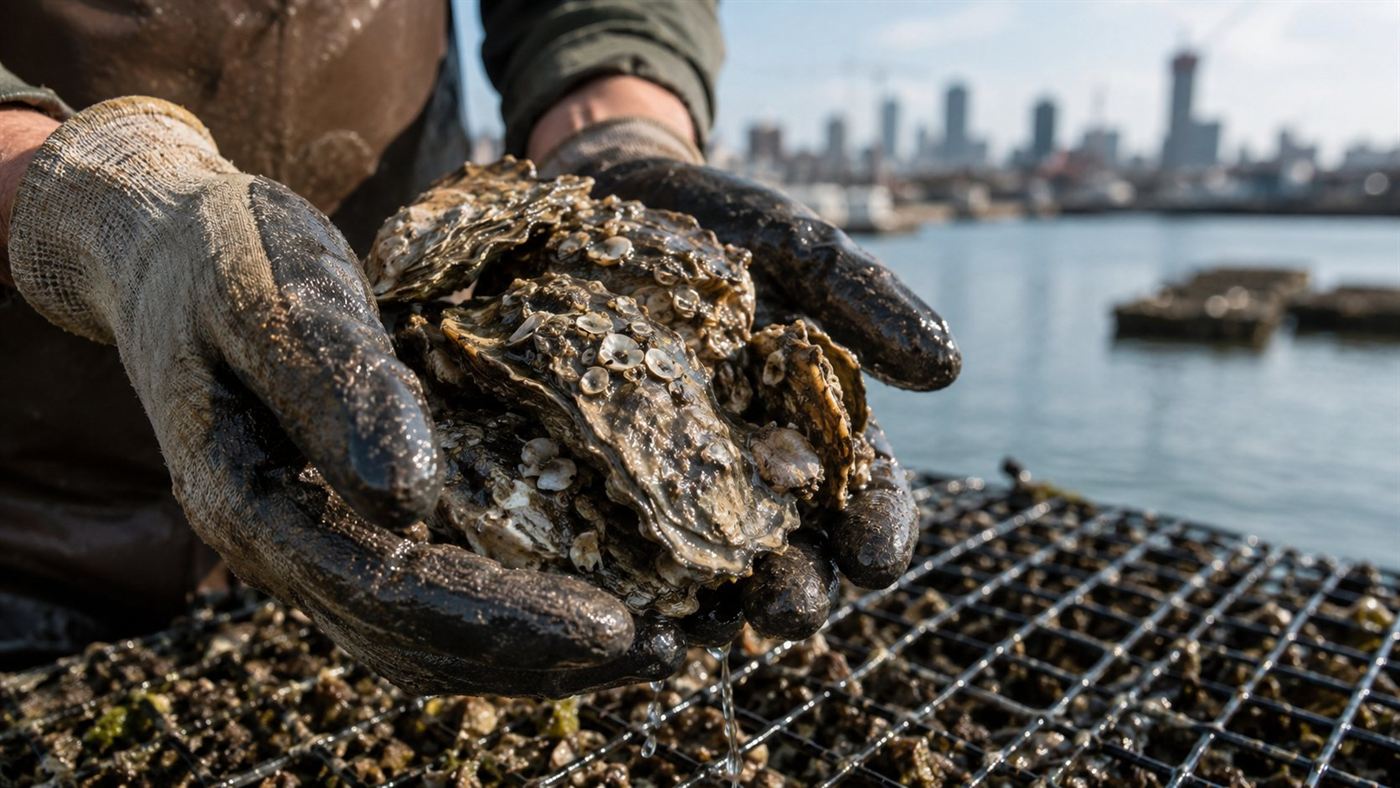
Here is what makes this different from a rock pile. The reefs are designed to be colonized by oysters, and oysters do something concrete never will: they build. As they grow and cement themselves together, they add mass and height to the structure, knitting loose stone into solid living rock and sealing over storm damage on their own. The wall, in effect, repairs and reinforces itself for free.
That self-building habit is why a living reef can keep up with a rising sea. NOAA notes that oyster reefs self-repair and grow vertically with sea level, and eastern oyster reefs can accrete at roughly 70 to 110 millimeters per year under the right conditions, fast enough to track current sea-level rise. A concrete seawall does the opposite. It is static, it deflects wave energy onto neighboring shores, and it needs costly raising and repair as the water climbs.
Even before the oysters arrive, the structure has already come alive. Within the first year, the breakwaters were colonized by shorebirds, seals, crabs, mussels, barnacles, sea sponges and a range of fish. The live oysters are being seeded in partnership with the Billion Oyster Project, with installation expected to finish by 2027.
A billion oysters, one recycled shell at a time
New York Harbor was once carpeted with oyster reefs, until pollution and overharvesting wiped them out. Rebuilding that lost world is the job of the Billion Oyster Project, a New York nonprofit that is restoring the harbor using oyster shells recycled from city restaurants and the labor of student volunteers. According to the Billion Oyster Project, the goal is one billion oysters in New York Harbor by 2035, with more than 150 million already restored across about 17 acres of reef.
It is worth being precise about who does what. The Billion Oyster Project is not the builder of the breakwaters; it is the partner seeding them with life. The structures are the engineering, and the oysters are the biology layered on top, two halves of the same idea, one designed to outlast the other by growing.
Oysters earn their keep beyond defense. They are filter feeders, pumping water across their gills to strip out algae, sediment and excess nitrogen, the same nutrient pollution that fuels dead zones. A harbor lined with reefs is a harbor that cleans itself, which is part of why restoring them is treated as water-quality work, not just storm work.
The honest catch
The headline numbers are softer than they first sound, and it is worth saying so plainly. The Living Breakwaters reefs are stone-and-concrete structures today; the oysters are an ecological enhancement still being seeded, not finished until around 2027, so the living protection is largely a future promise rather than a finished fact. The verified design spec for Staten Island is simply that waves reaching the coast drop below three feet.
The eye-catching percentages belong elsewhere. The 76 to 93 percent wave-energy cuts come from Gulf Coast field studies, not from this site, and reef attenuation falls off sharply once water rises above the reef crest, which is exactly when a big storm surge is at its worst. The often-quoted figure that a single adult oyster filters up to 50 gallons of water a day is, as the Bay Journal reported, an idealized maximum scientists say is rarely reached in the wild, depending heavily on temperature, food and conditions.
And the self-rising reef only outpaces sea-level rise where larval supply, water quality and exposure time all cooperate. Where they do not, the oysters lag and the advantage shrinks. This is a living system, with a living system's caveats.
Why a cheaper, growing wall still matters
Even with every caveat, the economics point somewhere new. NOAA puts oyster-reef restoration at roughly $2,260 per hectare in the United States, against more than $1 million per hectare for engineered bulkheads and breakwaters. A simple living shoreline can cost a tiny fraction of a hard one and then maintain itself, while concrete only depreciates from the day it is poured.
Living Breakwaters is the expensive flagship, not the cheap norm. At $111 million for 2,400 feet, it is far costlier per foot than ordinary reef restoration, because it is a fully engineered, storm-rated structure with a research and education mission bolted on. Its value is partly as proof of concept, a high-profile test of whether a major American city will defend its coast with something that breathes.
The deeper appeal is the reversal at its heart. Nature becomes the engineer that maintains the infrastructure for nothing, and the barrier is designed to get stronger as the threat it guards against gets worse. A concrete wall is at its best the day it is built and declines from there. A reef, if it takes, is at its weakest the day it is built and grows from there.
New York spent $111 million to find out whether a coastline is better defended by a wall that dies or a reef that grows. The first wildlife moved in within a year, and the oysters are due by 2027. Would you trust a living reef to guard your coast over a solid concrete seawall? Tell us what you think in the comments.
Related reading: China has begun building a 137 billion dollar megadam in the Himalayas.