BYD's new megawatt platform charges an EV with about 400 km of range in just 5 minutes at a record 1,000 kW, roughly as fast as a petrol fill-up
For years the knock on electric cars was the wait, a coffee-break stuck at a charger. BYD's Super e-Platform claims to end that, pushing a full 1 megawatt into the battery to add roughly 400 km of range in about five minutes, nearly as fast as filling a tank.
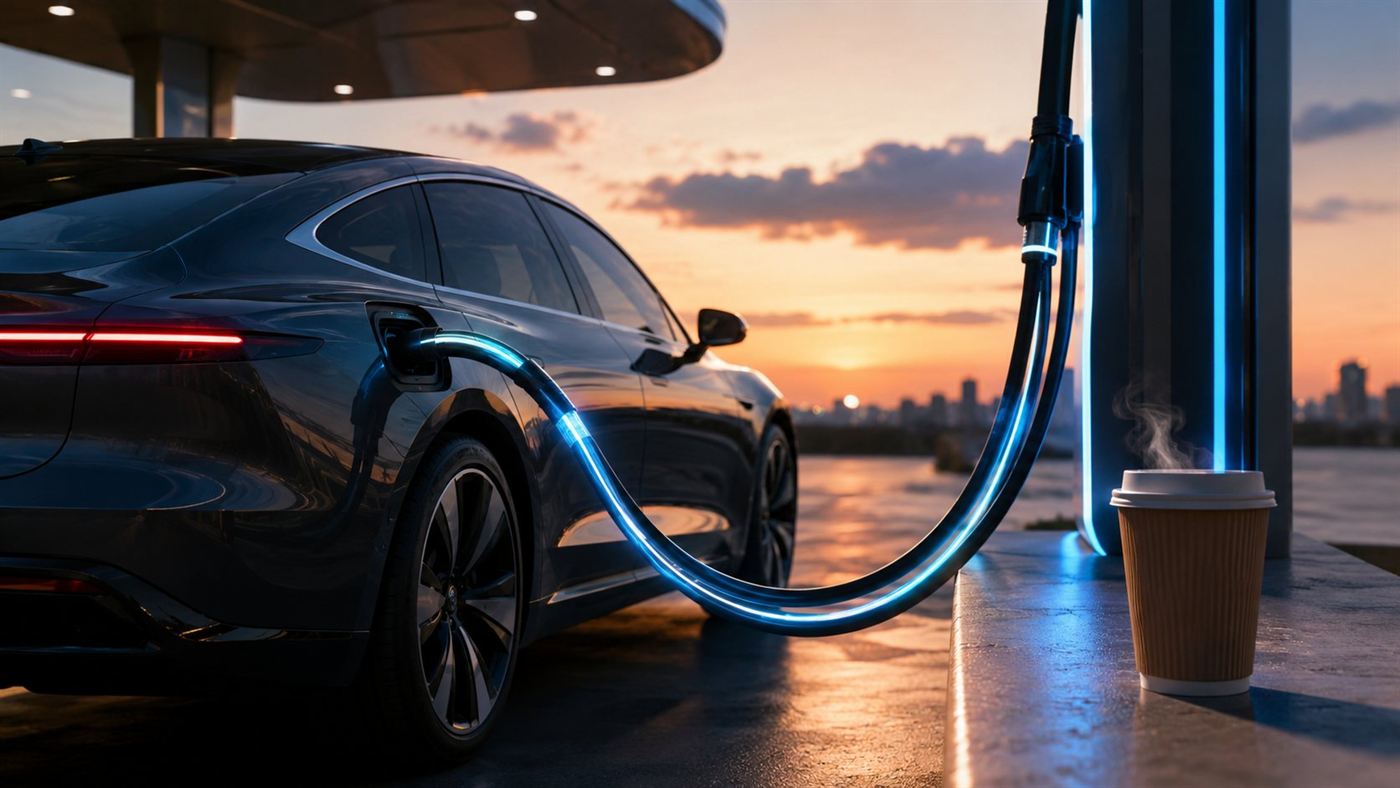
A full megawatt into the pack, in about the time it takes to drink a coffee. Illustration: Watts & Wild.
The biggest reason people still hesitate to buy an electric car has never really been the price or the range on paper. It has been the wait. Pull into a fast charger, plug in, and you are looking at twenty, thirty, sometimes forty minutes of standing around while the battery fills. On March 17, 2025, BYD walked on stage in China and said it had killed that wait. The Chinese giant unveiled its Super e-Platform, which it calls the world's first mass-produced full-domain 1,000-volt architecture for a passenger car.
The number that made the room go quiet was 1,000 kilowatts. That is a full megawatt of charging power flowing into a car battery, enough, BYD says, to add about 400 km of range in roughly five minutes. As Electrek reported on the day of the announcement, BYD framed it as the world's fastest charging for a mass-produced car, with a headline speed it described as two kilometres of range for every second plugged in. The first cars to carry it, the Han L sedan and the Tang L SUV, opened for pre-order in China the same day.
What a megawatt actually means
To understand why this is a leap and not just a bigger number, look at how BYD got there. Charging power is voltage multiplied by current, and BYD pushed both to extremes at once. The Super e-Platform runs at 1,000 volts across the whole car, unifying the battery, the motor and the power supply at that voltage, and it pairs that with a current of 1,000 amps. Multiply the two and you land on 1,000 kilowatts, which BYD says is the largest charging power ever fitted to a mass-produced vehicle.
For comparison, a Tesla Supercharger tops out around 250 kW, and most public fast chargers sit well below that. BYD's peak is several times higher. As paultan.org detailed, the platform is a true full-domain 1,000V system, meaning the high voltage is not confined to the charging port but runs through the motor and the rest of the drivetrain, which is what lets the car swallow that much power without melting.
BYD did not stop at the car. To feed a full megawatt into one vehicle, ordinary chargers are nowhere near enough, so the company built its own. CnEVPost covered the launch and the 1,000-kW supercharging support alongside the Han L and Tang L going on pre-sale. The hardware behind it is an all-liquid-cooled terminal that can output up to 1,360 kW, and BYD said it plans to build more than 4,000 of these megawatt flash-charging stations across China.
The battery that makes it possible
None of this works without a battery cell that can accept the punishment. The headline component is what BYD calls its Flash Charging Battery, and its standout spec is a charging rate of 10C. That figure means the cell can take in ten times its own capacity in current, a rate BYD describes as a world record for a production battery, and it is the real engineering story underneath the marketing.
To hit 10C without the cell overheating or degrading, BYD reworked the internal chemistry. The company says it used ultra-high-speed ion channels that cut the battery's internal resistance by about 50 percent, which is the resistance that turns fast charging into wasted heat. Lower resistance means more of that megawatt goes into storing energy and less into cooking the pack.
The debut cars showed off the rest of the package too. The Han L and Tang L arrived with a new mass-produced electric motor spinning at 30,000 RPM, and BYD's own in-house 1,500-volt silicon carbide power chips, the kind of high-voltage semiconductor that makes a 1,000V system practical in the first place. This is a vertically integrated stack, with BYD building the battery, the motor, the chips and the charger itself.
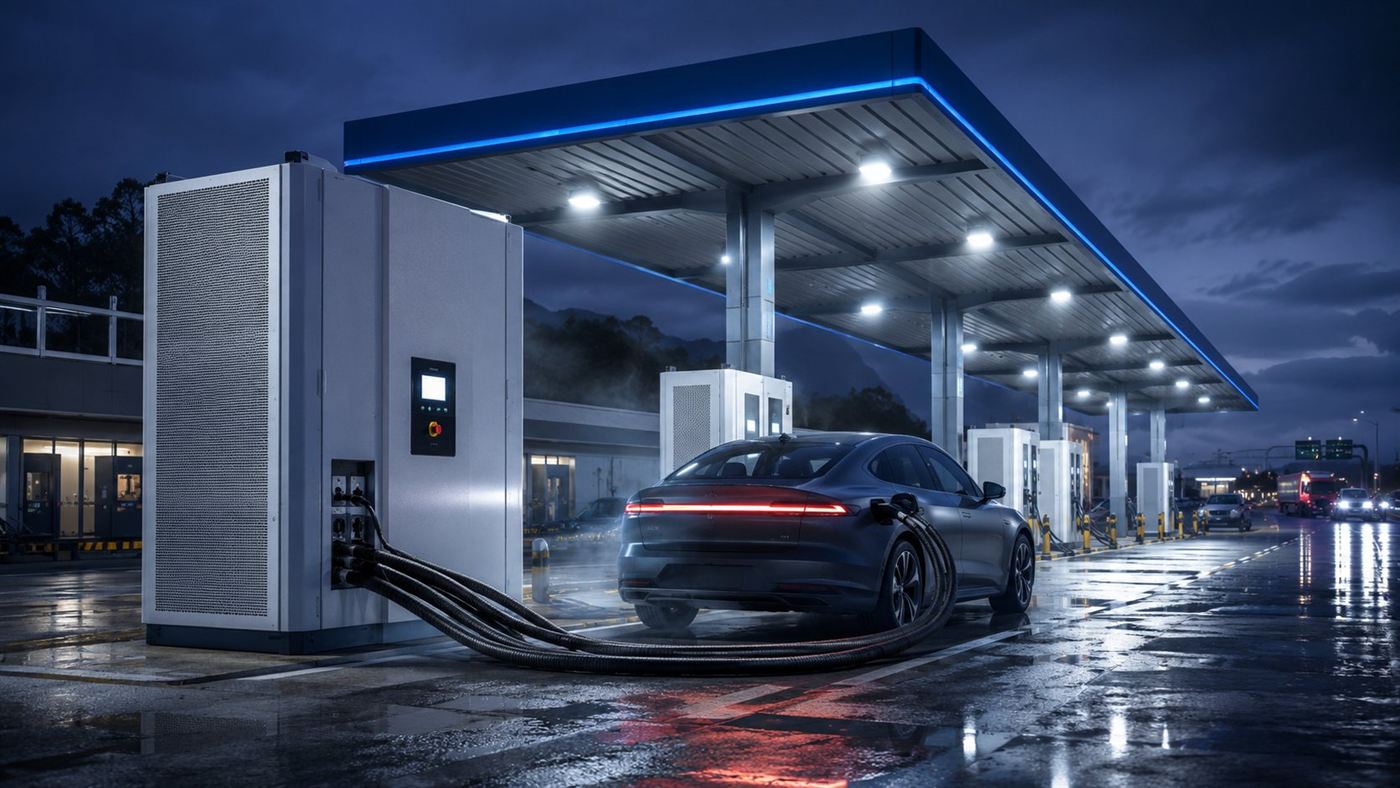
It already happened in the real world
A spec sheet is one thing. A car charging on a public street is another, and that is what makes the December 2025 demonstration matter. In Shanghai, BYD plugged a production Han L into one of its megawatt terminals in front of cameras, and the numbers held up well enough to turn heads.
As InsideEVs reported, the Han L peaked at 1,002 kW before tapering to about 463 kW, charging from 13 percent to 60 percent and adding 421 km (262 miles) of range in under five minutes. The outlet noted that this was roughly three times faster than the best EV-and-charger combinations available in the United States at the time.
That demo actually beat the original spec on distance, adding 421 km against the 400 km BYD had promised. The reason for the gap is partly that the demo ran from 13 to 60 percent, the sweet spot of the charging curve where a battery accepts power most eagerly, rather than a full top-up. It is a genuine result, and it is the kind that rivals a quick stop at a petrol pump.
Why this changes the calculation for drivers
The significance is not really about any single number. It is about a behaviour. A petrol driver thinks nothing of a five-minute stop, and that ease is one of the last big things electric cars could not match. If charging genuinely takes five minutes for hundreds of kilometres, the road trip math changes, and the anxious gap between EV and combustion narrows to almost nothing.
BYD's own framing, captured in the company's newsroom announcement of the Super e-Platform and its flash-charging battery, is exactly this, matching refuelling speeds. That phrase is the whole pitch. The point of a megawatt is not to brag about wattage, it is to make plugging in feel like filling up, so that range and charging stop being reasons to hesitate.
The honest catch
Here is where the excitement needs a cold splash of reality. The headline megawatt only happens on BYD's own ultra-powerful, liquid-cooled chargers, the ones the company still has to build. Plug a Han L into an ordinary public charger and you get nothing close to 400 km in five minutes. The whole feat depends on a charging network of 4,000-plus stations that mostly does not exist yet, and the rollout timeline outside China remains unclear.
There is a second asterisk on the speed itself. Even in BYD's own best demonstration, the power did not hold at a megawatt. It touched 1,002 kW for a brief peak and then tapered to around 463 kW, less than half the headline figure, for most of the session. The 1 MW is real, but it is a momentary spike, not a sustained rate, which is normal for fast charging but worth saying plainly.
And the range figure carries the usual fine print. The 400 km is measured on China's CLTC test cycle, which is more generous than the US EPA standard, so real-world range from a five-minute charge will land lower than the brochure suggests. None of this erases the achievement. It just means the gap between the launch slide and your driveway is still being built, one megawatt station at a time.
For the first time, an electric car company has put a number on the table that genuinely rivals the petrol pump, even if the chargers to deliver it are still going in the ground. Would a five-minute charge be the thing that finally convinces you to go electric? Tell us in the comments.
Related reading: China is putting a battery made from salt into cars.